
CineSavant Column
Hello!
Good old CineSavant host Trailers from Hell, where our reviews reside, has launched an improved page, with a different look and (I am assured) a wealth of functional improvements. It is said to run more smoothly and suffer fewer glitches.
Today’s CineSavant reviews are the latest I’ve uploaded with a new publishing process … we’ll see if I’m successful. There are a few bugs which will likely be fixed or addressed in the next couple of days. I like the way the reviews display, but the font size undergoes a change after the first paragraph and I think it ought to be uniform. More importantly, the ‘top photo’ on each of my reviews is missing … and I’ll be looking to see that fixed. There are 4,000 of them so hopefully they’ll pop up automatically. Otherwise, the planning seems very smart and considerate … I think it will be smooth sailing very shortly.
That’s important because we have a LOT of reviews to write!
And now for something different, a little think-piece contemplating Influences that are hard to pin down.
Years ago we were intrigued to learn that Jefferson Airplane’s old song Crown of Creation had lyrics (and its title) lifted directly from The Chrysalids, a 1955 novel by that grand old man of British Science Fiction, John Wyndham.
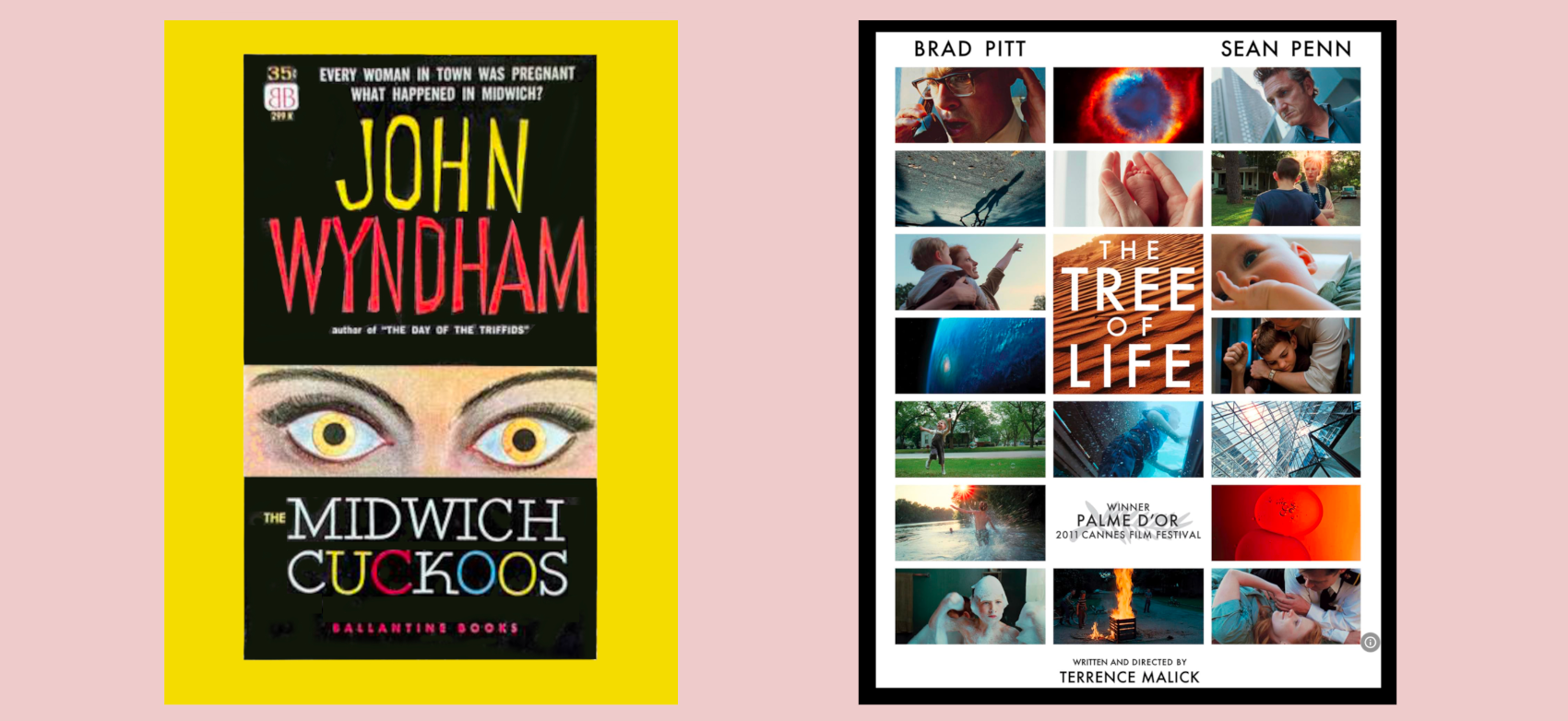
A few nights back we decided to re-read Wyndham’s popular novel The Midwich Cuckoos, the imaginative, scary shocker that became Village of the Damned, the classic Sci-fi thriller about the weird children with ‘the eyes that hypnotize.’ We last read the book around 1972 …
… and it read well, even if some aspects did seem a bit dated. But one paragraph jumped out at us. Other sources suspect that it provided inspiration for a later artist, in this case writer-director Terrence Malick. This time around it’s not quite a full quote. The paragraph is a statement about woman’s place in the cosmos … and may be a bit dated itself. It reads as follows:
‘Man’s arrogance is boastful,’ he observed, ‘woman’s is something in the fibre. We do occasionally contemplate the once lordly dinosaurs, and wonder when, and how, our little day will reach its end. But not she. Her eternity is an article of her faith. Great wars and disasters can ebb and flow, races rise and fall, empires wither with suffering and death, but these are superficialities: she, woman, is perpetual, essential; she will go on for ever. She doesn’t believe in the dinosaurs: she doesn’t really believe the world ever existed until she was upon it. Men may build and destroy and play with all their toys; they are uncomfortable nuisances, ephemeral conveniences, mere scamperers-about, while woman, in mystical umbilical connexion with the great tree of life itself, knows that she is indispensable. One wonders whether the female dinosaur in her day was blessed with the same comfortable certainty.’
Like we did, you might also make a connection with Malick’s monumental ethereal-cereal epic The Tree of Life … its title also quotes a line from a John Wyndham book. The subject of the paragraph is women as the source of life, which is a major concern in Malick’s film. And then there’s the out-of-left-field concern with a dinosaur, which in Malick’s film becomes a bizarre sequence. Is Malick’s dinosaur supposed to be female? The movie observes what might be a moment of very non-reptilian mercy … not Wyndham’s allusion to a dinosaur with motherly instincts.
You be the judge … it’s not exactly the most meaningful mystery to contemplate, but we’ll take what we can get.
Thanks for reading! — Glenn Erickson