
CineSavant Column
Hello!
Michael McQuarrie has located an item that’s old news to Stuart Galbraith IV, but fresh fun for us. Back in 1965 the movie importers Bercovitch and Saperstein were in the middle of a deal with Toho. They licensed several genre pictures for U.S. consumption, which is how we first saw such items as Frankenstein Conquers the World, Invasion of Astro-Monster and War of the Gargantuas. So far, so good — Saperstein distributed them theatrically and for TV through American-International.
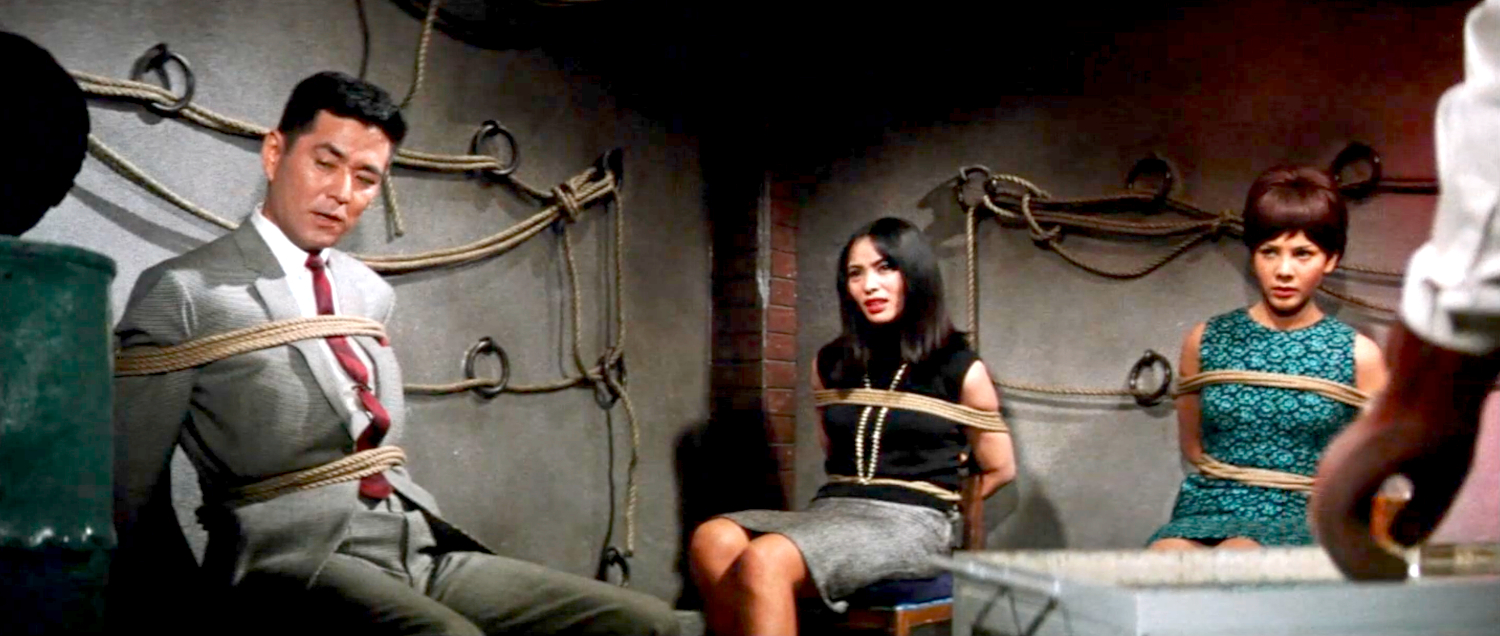
Included in the deal was the non-monster International Secret Police: Key of Keys, a light spy spoof with a notable cast: Tatsuya Mihashi, Mie Hama, Akiko Wakabayashi and briefly, Kumi Mizuno. It wasn’t a good sell in America, as the action and humor was definitely pitched to Japanese taste. But the importers came up with a creative idea.
Comedian Woody Allen was then trying hard to launch himself as a movie writer-director. He took on the job of recutting and redubbing Key of Keys as a looney comedy, also to be released by A.I.P.. Allen redubbed an entirely new storyline and characters onto the show, using a core of friends and associates as writer-performers: Frank Buxton, Louise Lasser, Julie Bennett, Len Maxwell, Mickey Rose and Bryna Wilson. The new track was an unbroken string of movie in-jokes and off-color humor. It was a smash at college screenings, in pan-scanned 16mm prints. Allen filmed an ending gag with himself and Playboy bunny China Lee; after he left the producers padded the film with scenes from another film in same Japanese series, and added several minutes of performance footage of The Loving Spoonful.
You had to have been there … the show has jokes about an Egg Salad recipe and non- PC names like Shepherd Wong, Suki Yaki and Wing Fat. The Japanese hero is ‘Phil Moskowitz, lovable rogue’; one of his girlfriends describes herself as ‘a terrific piece.’ It’s fun hearing Allen and Louise Lasser’s voices throughout the movie.
The campy title for this hybrid was What’s Up Tiger Lily? Isn’t there a character in Peter Pan called Tiger Lily? Why didn’t Disney come down on Saperstein like ‘Cobra Man,’ with his deadly electric wires.
This Internet Archive proudly presents the entire source movie from which What’s Up Tiger Lily? … it’s in Japanese with closed captions. Akiko Wakabayashi and Mie Hama became familiar faces when they were both cast in the James Bond movie set in Japan. Woody Allen later disowned the film entirely.

Another Michael McQuarrie good one: a 1963 TV special about the Hanna-Barbera animation studio, filmed at its then-new fancy facilities in the middle of Cahuenga Pass, a half-mile from Universal City.
It’s a general fluff piece with host George Fennemann learning how TV cartoons are made. After struggling for acknowledgement at MGM, the creators of Tom and Jerry struck gold with their simplified, audio-driven cartoons for TV. By 1960 they had a corral of titles and characters and a production machine that all but printed money.
We’re supposedly seeing the development of the character Magilla Gorilla, or at least see him being trotted out for more series fun. A writer gives an enthusiastic pitch: “I’ve got six stories based on bananas!” By this time Hanna & Barbera were hardworking salesmen, distributing their cartoon successes on TV everywhere in the world, on kiddie shows and in prime time series.
I watched because I recognized the Hanna-Barbera studio building as something I visited about 1974. My late associate Robert S. Birchard entered the film industry as an H-B sound cutter, where everything was done on mag-striped 35mm film. The sound library was enormous. The audio tracks got a lot of attention, because the cartoons were basically radio shows with as little animation as possible, and acres of recycled action. Every run cycle began with a character spinning his legs while a ‘hero’ effect played, a quick bongo riff followed by a ‘Zing’ noise when the character sped off in a minimal-animation blur. How Bob did the work I don’t know — the sound effects were codified, to a master plan — one deviated from the formula at one’s peril.
Thanks for reading! — Glenn Erickson