“Él” — 4K 12/02/25
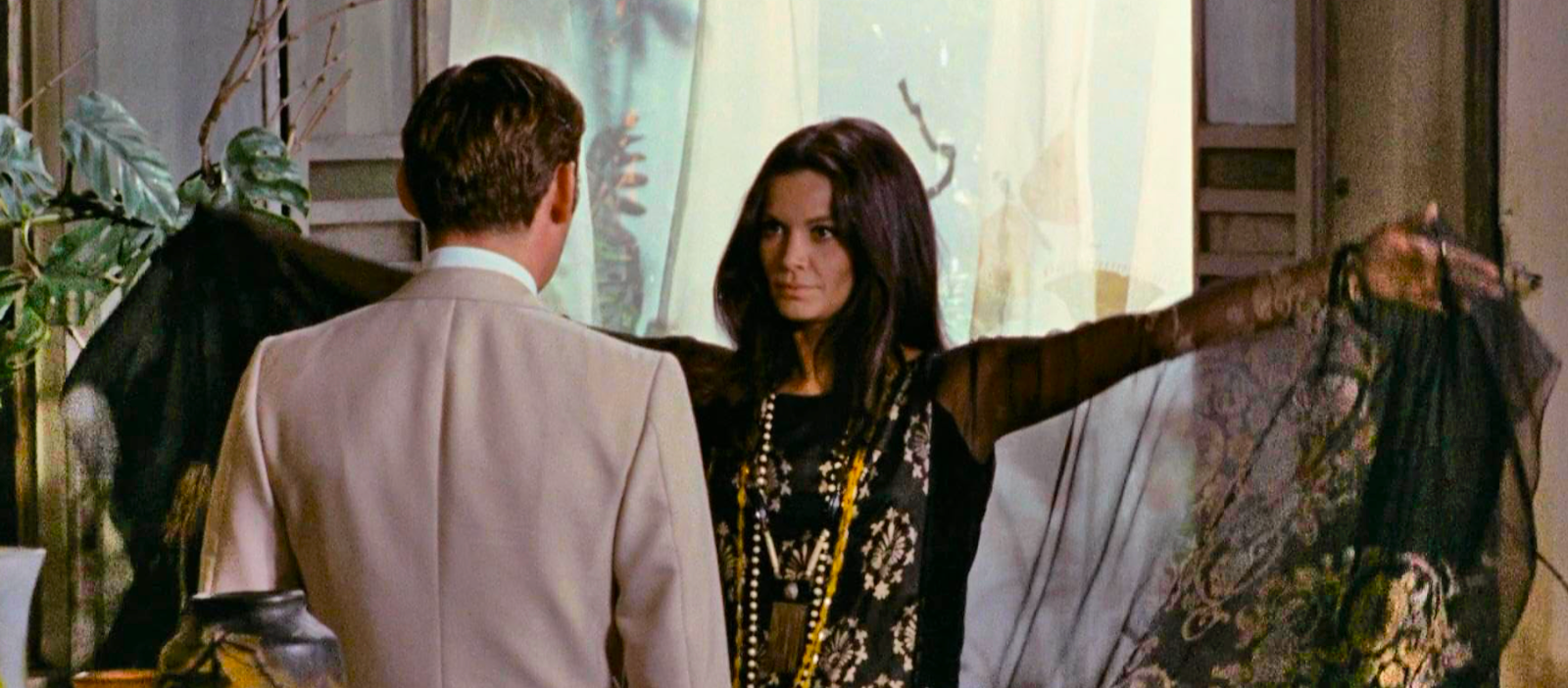
Luis Buñuel’s most personal drama billboards a ‘strange obsession’ yet ends up expressing the full injustice of the sexual status quo in polite society. A pillar of the community marries but finds his skewed notion of a romantic ideal betrayed from the start. Paranoid machismo and toxic jealousy is an entryway to full-on mania. The surreal is present but always at the service of truth. Matinee idol Arturo de Cordoba externalizes Buñuel’s internal contradictions for a character most men will recognize as at least partly in themselves. Filmed by Gabriel Figueroa; with excellent extras including a full half-hour of Buñuel in a candid interview. On 4K Ultra HD + Blu-ray from The Criterion Collection.
12/02/25
A Summer Place 12/02/25
Look at She, she’s Sandra Dee! 1959’s most sexed-up soap drama came with beautiful actors, Technicolor scenery and a tune that the radio wouldn’t stop playing. In a Place not too far from Peyton, is it always summer? The sordid fun includes divorce, frigidity, alcoholism, class snobbery, teen angst, teen sex fears, a teen sex drive, and music that says grab a blanket and find someplace secluded. Sandra Dee became America’s teenaged doll, and Troy Donohue more than a flash in the pan; the advertising tried to make it all seem as salacious as possible. Gosh, what do Good Kids really get up to on summer vacations? On Blu-ray from The Warner Archive Collection.
12/02/25
CineSavant Column
Hello!
Friend and advisor Craig Reardon sends along a Cleveland Live Music link to an older TV interview that’s been up for about a year.
Host Bob Costas talks with a relaxed James Coburn about subjects that most interest his fans — his western movies, Bob Dylan, Sam Peckinpah, Charles Bronson, etc.. The actor who most influenced Coburn? Mickey Rooney, Apparently.
The Milestone Newsletter is closely associated with the Association of Moving Image Archivsts, and this month has a link to a sample of the kind of fare exhibited at the AMIA Screening Nights program, described as “an opportunity for archivists to share and to showcase recent acquisitions, discoveries, and preservation efforts — from the sublime to the hilarious.”
The films for preservation are eclectic in nature: industrial shorts, odd commercials, independent efforts. The article explains how Milestone’s Dennis Doros found ways to make the AMIA Screening Night finds available to the public. A link found at the end of
leads to a sample reel of AMIA Screening Night fare … odd bits and pieces of rescued films.
Thanks for reading! — Glenn Erickson
Burden of Dreams 4K 11/29/25
Is that Werner S. Herzog, for Sisyphus? What filmmaker goes out of his way to make his work impossibly difficult? Werner Herzog did just that on Fitzcarraldo and filmmaker Les Blank documented the entire frustrating, risky process, which included the insane engineering feat of hauling an enormous steamboat over a hill. Herzog chose to shoot in an absurdly remote jungle, where warring tribes forced a location change. We see bits of the aborted first try with Jason Robards and Mick Jagger; Klaus Kinski and Claudia Cardinale are great replacements. But nothing matches Herzog’s ‘fornicating jungle’ speech, or Kinski’s panic on a runaway ship rushing down a river gorge. Extra fun: the legendary short subject Werner Herzog Eats His Shoe. On 4K Ultra HD + Blu-ray from The Criterion Collection.
11/29/25
The Diabolical Dr. Z 11/29/25
Nothing says ‘holiday time’ quite like jolly Jess Franco, so we asked UK correspondent Lee Broughton to cover of one of the mad Spaniard’s early films. This one features both medical horror and cold, calculated revenge. A coherent narrative, a stylish look and some reasonable technical qualities might surprise viewers familiar only with Franco’s later ‘film-as-jazz’ approach to movie-making. On Region B Blu-ray from Eureka! Classics.
11/29/25
CineSavant Column
Hello!
First, Joe Dante sends along an odd item, which he dubbed ‘a TV spot by a law firm with a sense of humor.’
Can’t get enough of those accident injury ads that cannot be avoided on TV? It’s a variation on one — and liberally basted with text disclaimers.
The cartoon starts about two minutes into this WDW Pro mini-docu about the legal fight that’s expected … 1928’s Steamboat Willie is in the Public Domain, but wouldn’t Disney have other rights covering the use of Mickey Mouse? It’s not as if the answer is automatic, apparently.
Mickey Mouse Stolen from Disney?
And a film archive discovery takes us to Indiana Univesity, where writer Eddie Stewart writes up a significant film find.
We just reviewed a 4K remaster of the silent film classic The Cat and the Canary …. but few know that Universal remade it just three years later as The Cat Creeps, a very early talkie directed by Rupert Julian. The show is featured in plenty of film books, but for most of the last 95 years all that’s existed of the film is a short clip – probably saved for a promotional trailer.
The short article explains it all. Apparently it’s not the whole film, so it’s not as if a re-premiere is in the works. But film historians would want to see it — the show was a big hit, starring Helen Twelvetrees, Raymond Hackett, Neil Hamilton, Jean Hersholt and Montagu Love.
IU professor Russell McGee made the big discovery simply by looking through a vault listing for the IU Bloomington Moving Image Archive. That sounds easy enough, making one wonder why the ‘lost’ film footage stayed lost for so long. The answer is access. The whole point of a protected vault is to keep just anybody from rummaging through it for no good reason. That’s definitely the case at film studios as well. Professor McGee should be congratulated for his initiative.
The discovery of course makes us think of all the film treasures that could conceivably be squirreled away in colleges and universities, libraries, corporate offices … A full print of a lost European classic was miraculously located in a Norwegian mental hospital. Who knows? Maybe in storage somewhere under some old accounting records are stacks of film cans labeled Mag.Ambers’s, or Lnd.Aft.Mid..
Thanks for reading! — Glenn Erickson
CineSavant Column Pre-Thanksgiving Edition
Hello!

Today is a good day for a Book Review …
… for an interesting little book called The Luminous Fairies and Mothra, from The University of Minnesota Press. It will become available in about 50 days, on January 13th, 2026. About two years ago, the UMP published the first English-language translation of the original 1955 ‘young adult novelizations’ of Toho’s first two Kaiju films, Godzilla and Godzilla Raids Again.
Although the projects share a translator in Jeffrey Angles, the new book is not a novelization. It is the original story that served as the basis for Toho’s 1961 kaiju Mothra, a classic Japanese fantasy. The giant moth known as Mosura is one of Toho’s most popular monsters.
We had always assumed that Mothra is a screen original, but its screenplay was reportedly adapted from a three-part magazine serial. It has three authors, each of whom penned a chapter: Takehiko Fukunaga, Yoshie Hotta and Shin’ichiro Nakamura. The story was commissioned by Toho Films to be the basis of a large-scale movie, and the serialized magazine story served as early advertising for the movie.
The finished movie was in theaters only seven months after publication. The primary screenwriter was Shin’ichi Sekizawa, who has screenplay credits on several other Toho giant monster movies and futuristic fantasies.
Mothra fans will jump to read ‘the official story’ on the huge insect from Infant island. The three installments of the novella are quite short, almost like a film treatment. One author hands off the story to the next, who continues in a different style altogether. The text leaves out most details and barely describes the spectacular action — with the idea that Toho’s technicians will fill all that in later. The final chapter reads as sketchy, almost an outline. As in the movie, Mothra does begin as a giant egg, and its ‘handmaidens’ are miniature princesses called the shôbijin. The first chapter goes deeper into the Island’s gods, with an explanation for the symbolic ‘sunrise cross’ on the stones of the Infant Islanders.

Translator Jeffrey Angles doubles as a film historian in an Afterword called Hatching Mothra, which comprises the larger second half of the book. The discussion of All Things Mothra begins with information on the three authors. As in the original Godzilla, with its pacifist & humanitarian theme, they gave their monster fairy tale a political edge.
As in the movie, the little novella comments on international relations between Japan and a fictional superpower responsible for Infant Island’s toxic level of radiation. In the original story the offending nation is called Rosilica … in the movie, it is Rolisica. The Rosilican entrepreneur-gangster Nelson kidnaps the shôbijin and exploits them for a theatrical gala in Tokyo.
We assume that most audiences take the fictional nation as a stand-in for the United States. In the movie, Rolisica’s ‘New Kirk City’ features The Golden Gate Bridge. But we also see Roliscan generals wearing uniforms that look very Russian. The idea is for Rosilica/Rolisica to be an amalgam of the Soviet Union and America. It’s a clever way of not taking sides.
The analysis in Hatching Mothra ranges from discussions of the origin of Godzilla, to the nature of exoticism in Japanese storytelling, to thoughts about Mothra’s gender. A close reading of the text ponders some Japanese grammatical details that might infer an attitude not communicated in the English translation. We are assured that the authors (and the screenwriter) were keen to push an ecological agenda, and to suggest that Japan play a stronger role in defending the Third World from superpower exploitation.
Author Angles is nothing if not thorough — his overview investigates the idea that Mothra may have been influenced by Hugh Lofting’s Doctor Doolittle book series, which were very popular in Japan. In two of the books, the Doctor travels to and from the Moon on the back of a giant lunar moth with the name ‘Jamaro Bumblelily.’
Devoted fans of Japanese fantasy will definitely be interested in The Luminous Fairies & Mothra. Jeffrey Angles has gone to the trouble of carefully translating the original (with footnotes) and compiling a thorough guide to the meanings and relevancies of this Kaiju fairy tale.
Perhaps the next logical target for translation would be Toho’s Sci-fi spectacle about a futuristic submarine, Atragon. It is said to be from multiple Japanese sources that include an adventure novel from 1900. Unlike Mothra, the movie of Atragon is politically pro-militarist!
And after the Book Review, a Slide Show.
About 6 years ago, before COVID, I posted some photos of the The Hollywood Forever Day of the Dead Celebration very close to home here in Los Angeles. Just up Gower Street and over the fence from Paramount Pictures, the Hollywood Forever cemetery is a reasonably short walk from CineSavant Central. ↑
It’s a very pretty cemetery, and a good place for food, music and lots of people running around with skulls painted on their faces. All of these shots get bigger; on the upper left of this picture can be seen part of the Hollywood Sign peeking out from behind a tree. ↑
The basic idea for the festival was to allow participants to build traditional Día de los Muertos altars to loved ones that have passed on. Back in 2019 there were dozens of those, arrayed in the formal manner. The celebration this year was smaller and seemingly aligned toward the musical performers scheduled for later in the evening. They may have screened a movie outdoors, as well.
There were some beautiful costumes to look at; here’s just one. I thought this would make for a semi-relevant CineSavant slide show because of several interesting celebrity-aligned not-really-altars that stood out on the cemetery walkways.
Guessing this one ↑ shouldn’t be difficult …
And this one makes sure we don’t get confused. ↑ Pay no attention to the troublemaker crashing the photo.
This elaborate setup appears to be very serious and committed to its honoree. ↑
A great many Hollywood personalities have been laid to rest in Hollywood Forever, starting back in the earlier part of the 20th century. Whenever we strolled through the place, we’ve always come across names that meant something personal to us. This photo I actually took long ago. ↑
When the time came to go home we decided not to walk down Gower. Finding the Van Ness exit took us through a newer section of mausoleum crypts. We didn’t poke through them looking for celebs, yet couldn’t miss three more noted personalities that stood out, this one and two more just below.
I did meet Mr. Rooney once, in 1972. Is meet the correct word? I was working as an usher at the long-gone National Theater in Westwood on a Saturday afternoon when he showed up to see his movie Pulp with Michael Caine, and I almost bumped into him on the stairs. Rooney grabbed my hand before I could speak and talked loud and fast for about 4 seconds:
He then performed a swift walk-away that said ‘don’t dare talk to me, kid.’ A couple of minutes later I saw Rooney being held captive by a family on a bench in the National’s glass-enclosed 2nd floor lobby, and being very nice about it.
The handshake was certainly better than a rough snub, and I always considered it a gift. Mickey Rooney would be instantly recognized by millions, so had to have some defense mechanism at the ready. In Los Angeles one soon learns to read ‘celebs’ to know how to behave. Everybody except me.
CineSavant correspondents say they like these pix, so here are a couple more. On the walk back home we passed Lemon Grove Avenue, an ordinary residential street that threads its way across Hollywood and comes to a stop on Van Ness where the cemetery begins. Could the ghost of Ray Dennis Steckler be far away? He later relocated to Las Vegas, but this neck of the woods is where he lived and produced his triple-Z movies, including his brain-numbing homage to the Bowery Boys, The Lemon Grove Kids Meet the Monsters.
What a scoop. They don’t print that kind of Hollywood history on the tourist brochures. I left the graffiti intact. Tourists flock to Hollywood — how many are dismayed to see so much (cough) street art?
On Melrose across from Paramount just a couple of blocks from CineSavant Central, we saw that somebody was sprucing up a famed Hollywood institution, the old ‘Lucy’s El Adobe Cafe.’ It’s been closed down for quite a few years, and the good news just this week is that they say it’s reopening. This local Larchmont article by Patricia Lombard spreads the good word.
We would welcome a Mexican restaurant in easy walking distance, and a lot of film history is associated with the cafe. Right outside on the sidewalk is (reportedly) where writer Billy Wilder learned from director Mitchell Leisen, that Wilder’s now-legendary Cockroach Scene had been dropped from the script and was not going to be filmed. Wilder blew a fuse.
And just think, I might be able to sit at the same table where, long ago, RKO editor Robert Wise was told that he had been promoted to directing, to finish Val Lewton’s The Curse of the Cat People. Yes, yes, I know, that’s your secret ambition as well.
See you on Saturday with some reviews!
Thanks for reading! — Glenn Erickson
Abbott & Costello meet Frankenstein — 4K 11/22/25
Yet another movie we dearly love, remastered in glowing 4K — a show that’s so much fun, who would want to poke about looking for faults? No fear there … Bud Abbott and Lou Costello seem to love the monsters as much as we do, and put out the welcome mat for Lon Chaney’s Wolf Man, Bela Lugosi’s Dracula, and Glenn Strange as the Frankenstein Monster. The 4K transfer emphasizes the high production values and a smart story that integrates laughs and horror-lite chills. Bud and Lou are at their best and Charles T. Barton’s direction builds to an action climax that tops most of Uni’s straight horror pictures. Also with Lenore Aubert, Jane Randolph and Frank Ferguson. On 4K Ultra HD from KL Studio Classics.
11/22/25
In the Mouth of Madness — 4K 11/22/25
Director John Carpenter applies himself to this solid attempt to (finally) nail down the H.P. Lovecraft ethos on film. The project and its script were actually initiated by its producer, Michael DeLuca. Thanks to our emotional connection with star Sam Neill, we stick with a horror hallucination nightmare that threatens to become its own in-joke. But we’re happy to see a Lovecraft film that follows through with its aim — to watch reality dissolve before our very eyes, as the world is reclaimed by Evil ‘Old Gods.’ On 4K Ultra HD from Arrow Video.
11/22/25
CineSavant Column
Hello!
Wow, a stack of fast links today. Advisor Gary Teetzel starts things by pointing us to an Ennio Morricone soundtrack, of which we were totally unaware.
In 1961 he created the score for an Italian radio adaptation of 20,000 Leagues Under the Sea…
… and we can listen to clips online.
Plus:
Ventimiglia Cue 2
Ventimiglia Cue 3
Plus The Actual Radio Show as released on record, or at least a portion of it:
Ventimiglia Radio Cue 1
Ventimiglia Radio Cue 2

The indispensible Michael McQuarrie sends along an interview we found fascinating … from 2023, it’s Kliph Nesteroff’s interview with actress Peggy Webber. It’s the sixth part (!) having to do mostly with her radio career … she quickly dismisses her starring film roles in horror pictures, mainly The Screaming Skull.
The detail about 1940s radio is fascinating, she even has some weird info about Orson Welles.
Those that care will waste no time checking it out … some of these ‘minor’ personalities lived pretty impressive lives.
Wanna debate the ins and outs of Time Travel, both in scientific theory and in fiction? David J. Schow circulated this dandy article just for that argument intellectual discussion.
It’s from 1440 dot Com, and it’s a long list of intriguing ideas, like the ‘grandfather paradox.’ Most entries link to afurther discussions (although the one I most wanted to read was behind a firewall).
So before you blow a wad of cash on your own Delorean, take a look:
Thanks for reading! — Glenn Erickson
Nightmare Alley (2021) — 4K 11/18/25
Reviewer Charlie Largent takes on a weighty show, Guillermo Del Toro’s stylish remake of the classic noir about a circus sharpie turned mentalist sensation. The picture had separate releases in color and B&W versions, both of which are present on the deluxe 4K presentation. Bradley Cooper is the unscrupulous crook Stanton Carlisle, supported by Cate Blanchett, Toni Collette, Willem Dafoe, and Rooney Mara. On 4K Ultra-HD + Blu-ray from The Criterion Collection.
11/18/25
The Master of Ballantrae 11/18/25
Errol Flynn is back in harness as an 18th century Scottish patriot who survives the Battle of Culloden only to fall in with pirates of the Caribbean. No, really — it’s from a novel by Robert Louis Stevenson. Flynn’s late career mini-epic tries to cover too much story and the direction isn’t distinguished, but Flynn is in good form and there are good scenes along the way. Compensating even more is the handsome Technicolor camerawork of Jack Cardiff and able acting support from English actors Roger Livesey, Anthony Steel, Beatrice Campbell and (swoon) Yvonne Furneaux. On Blu-ray from The Warner Archive Collection.
11/18/25
CineSavant Column
Hello!
We’re now in the roll-up days before Thanksgiving. The national news coverage makes us think California is a rain disaster area, but CineSavant Central is so far only getting moderate rain. So we’ll have to wait for an earthquake or another freak firestorm to put us back on the Threat Board. I hope readers back East in all the terrible weather WE see are doing okay.

Meanwhile, CineSavant Column items keep bouncing back, and in a fun way.
Author Tom Weaver followed up on the story about the 1958 The Fly that we posted last Saturday. It’s about an off-color trade ad for the movie, that we have repeat-posted again here on the left. ← You’ll likely want to enlarge these images to see them better.
As expected, Tom was on the story long ago, having touched on the 1958 trade ad when interviewing the film’s star David Hedison. The actor said that the original ad was a double-page spread in The Motion Picture Herald.

We were intrigued because the trade Ad made us wonder ‘wouldn’t anybody complain about that?’ Tom Weaver’s follow-up shows that apparently somebody did, that somebody being the head of the Motion Picture Association.
In the first of two additional clippings forwarded by Tom, Variety said on July 23 of 1958 that the original was first seen in a different trade paper. To quote Variety:

“Prodded by the Johnston office (the MPAA), 20th Fox changed the text of an ad for “The Fly” last week, but not before it had run in The Motion Picture Daily to a good deal of surprised trade comment.”
So somebody did think that ad offensive. The mini-article explains that the ad was used again, but with a less fun a less eye-opening wording.
Here’s the incontrovertible evidence! ‘Before’ and ‘After’ ads, and a mini-blurb about the first version that was “too much for the MPAA.”
So once again, the CineSavant Column can take its proud place at the head of American journalism.
And we’ve got room for an enthusiastic plug for a lavish new disc release.
Arrow Video’s fourth monster box of Hong Kong martial arts pictures goes fantastic, with 16 full features, all restored, all viewable in multiple languages and versions, and all appointed with expert extras.
The content gets very weird, what with fantasy spectacles filled with visual effects. I remember seeing titles like Super Inframan playing back when Los Angeles had hundreds of neighborhood movie theaters. I should think that the bulk of the movies in this collection will be new genre territory for a great many fans … the kind of fans that collected blurry, oddly scanned and poorly dubbed VHS tapes ‘back in the day.’
It’s a pricey item positioned to move as a Christmas disc … Arrow says that it will be released on December 9. I’m starting with the bonus disc with a docu on the Shaw Brothers … everything in it will likely be news to me.
Thanks for reading! — Glenn Erickson
Hell’s Angels — 4K 11/15/25
A 4K remaster puts a high polish on Howard Hughes’ WW1 air war epic — an enormous personal project that allowed the playboy tycoon to indulge his obsessions for women, movies and especially aviation. The film’s air combat has never been equalled: some shots have upwards of 30 aircraft buzzing through the clouds at the same time. The film made Jean Harlow an instant star; he even included a color sequence to show off her platinum hair. The sex attitudes are frank and shameless, and Harlow bares a lot in the name of pre-Code license. The new uncut disc is ‘multi-aspect ratio’ — the home video screen adjusts for a 1930 gimmick called ‘Magnascope.’ On 4K Ultra-HD + Blu-ray from The Criterion Collection.
11/15/25