
CineSavant Column
Hello!
Just a couple of semi-personal notes at today’s Column. I was intrigued to listen to Nathaniel Thompson’s ideas about disc storage the other week, and have been corresponding with readers giving more advice. I am steadily progressing with my project to liberate the house from the tyranny of being overrun by discs.
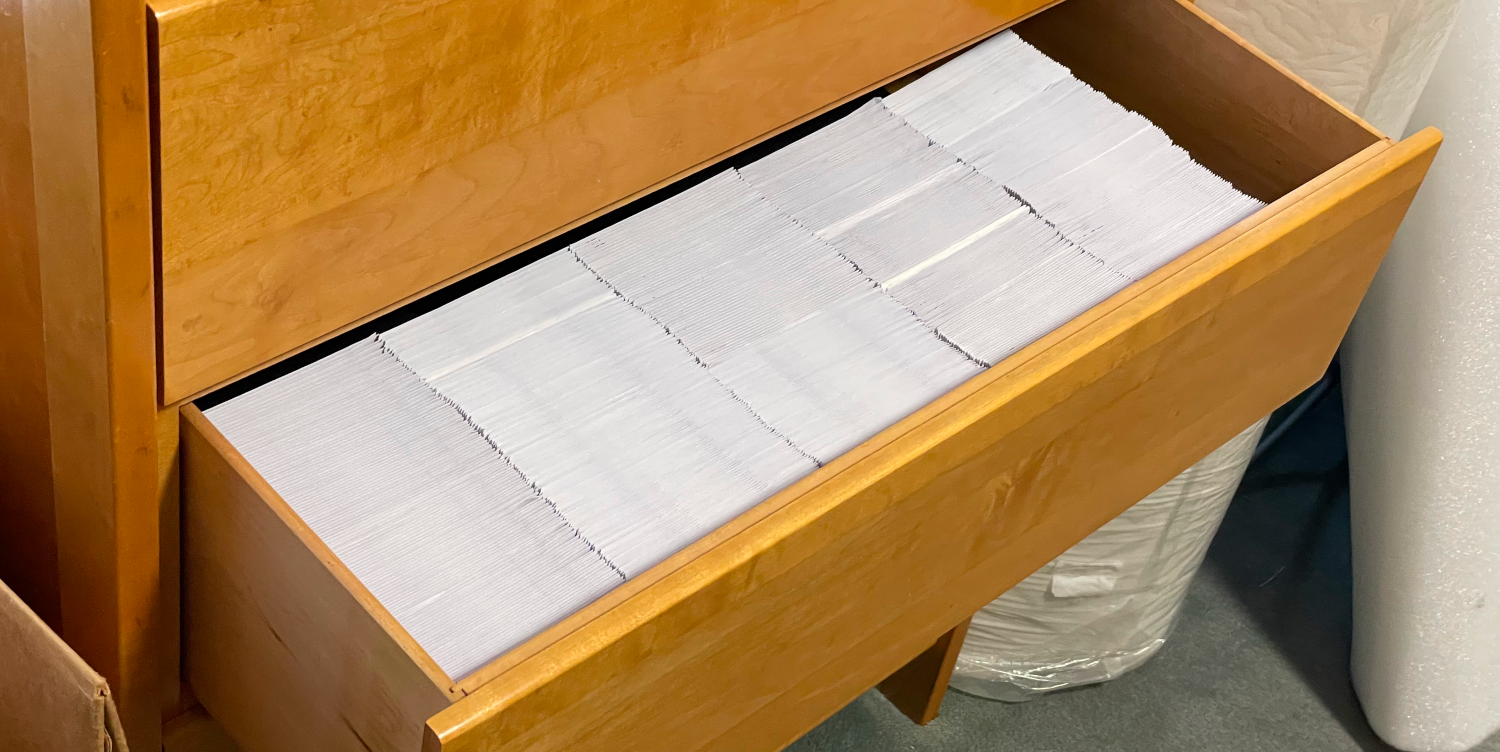
I’m up to about 1700 discs repackaged in envelopes, and they’ve almost filled up a full dresser of drawers … one more drawer to go. I’m ‘enveloping’ far more DVDs than BDs, and trying not to discriminate — I have at least 3 copies of the movie Chinatown, including a 1998 DVD that’s not even 16×9 enhanced. I guess I’ll be able to help some student do a study on the progression of disc encodings? Not so sure about that, but I do know that I’ve sorely missed a disc or two that I lost track of — that excellent BD of Raw Deal must be behind a piece of furniture somewhere.
The sleeves and booklets are numbered and stacked in boxes, about a 1,000 titles to a box. We’ll see how well that effort works.
So far I have at least a dozen more big boxes of discs to ingest into this system, and after that I’ll go through the ten or so shelves and weed out discs that can be consigned to the envelope list. I’m hoping that thinning out what’s displayed on shelves will have a double benefit: we may finally be able to locate anything fairly quickly — and my shelves might better reflect my personal taste, too. Figuring out what to do with these discs is based on some hard decisions: 1) There must be 10,000 collectors with collections bigger than mine, so I won’t operate under the illusion that I’m safeguarding a precious treasure. 2) Nothing is permanent, especially not me. The idea is to arrange this stuff so it can be enjoyed, without being a problem for the future.
We may check in with more progress later. … ?
We’ve lived in Los Angeles for 56 years and have only seen maybe a quarter the city, even if there are dozens of district names I’d need to search for on a map. One place I’ve never been to is where Venice Blvd. meets the beach, the sand-adjacent walkway with its permanent circus atmosphere. I’ve not been a fan of crowded places — we’ve hung out between the Santa Monica Pier and Ocean Park a lot, but have only seen the Ground Zero of the Venice Beach walkway in movies.
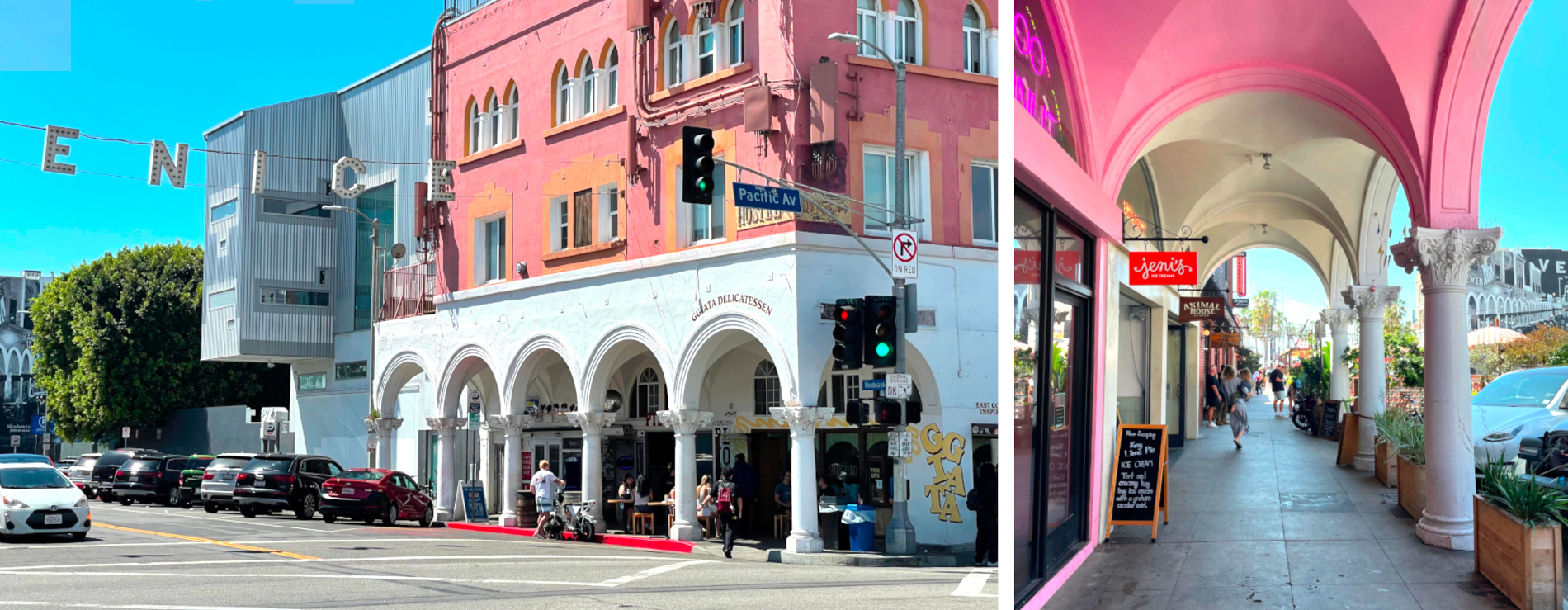
Well, we had a need to seek out a recommended food stand on the Boardwalk, and ventured there last Sunday, just to try our luck. It was something of a miracle that we chanced on a parking spot just a 3 blocks away. Some film location expert I am … I thought that the iconic Venice ‘collonade’ streets were further north, and had been comepletely eradicated. I was looking in the wrong spot … at Venice Way and the beach there still exists a partial block of the buildings with the columns made immortal by the movies Touch of Evil and Dementia. Some Angeleno I am, reporting on something everyone here knows well, except me.
There are more remaining columned buildings than seen in the photo. They are spaced out a little, but are obviously Touch of Evil’s Los Robles, where two full blocks carry the same design. The movie gives the impression of a seedy border town that exists only at night. Hints of a sandy nothingness beyond peek through between the buildings, like a landscape in a Dalí painting.
Today it’s of course hemmed in by dense development. It makes sense that one angle at the end of the block just shows darkness — that’s the beach, with the waves maybe 90 yards away. A half-block inland is the long street-alley where Charlton Heston is driven at breakneck speed, in a daylight scene. We can see more of what there is to the South — oil derricks, a lot of them. There were once many more ersatz Venetian canals, with those quaint bridges like the one where Marlene Dietrich and Orson Welles make different exits.
Roger Corman’s Wild Angels has daylight scenes around the canals and the oil wells. Curtis Harrington’s Night Tide, Jacques Demy’s Model Shop and Jacques Deray’s The Outside Man give us a wider tour of what the area once looked like … back when a student could be reasonably poor and still live in L.A.. The biggest surprise, however, was seeing the area covered in Denis Sanders’ 1959 Crime and Punishment U.S.A.. The movie is no great shakes but the Venice locations are eye-opening. A view looking South from a rooftop reveals scrubland with an unending forest of oil derricks, like something from an Oil Boom western. No wonder rent down there was cheap, with all that industrial activity.
Hope this hasn’t been a waste, see you Tuesday.
Thanks for reading! — Glenn Erickson