
CineSavant Column
Hello!
Happy two days after Christmas. You think your day was special — I got new bath towels … to replace a set so frayed, you’d think an animal had torn them. The nice thing is that it felt like a real treat. Correspondent “B” in New York sent me a fancy Big Apple coffee cup, and a compendium book of Nancy comics. My granddaughter is just old and patient enough to maybe enjoy them with me, the next time we get together. So no complaints here.
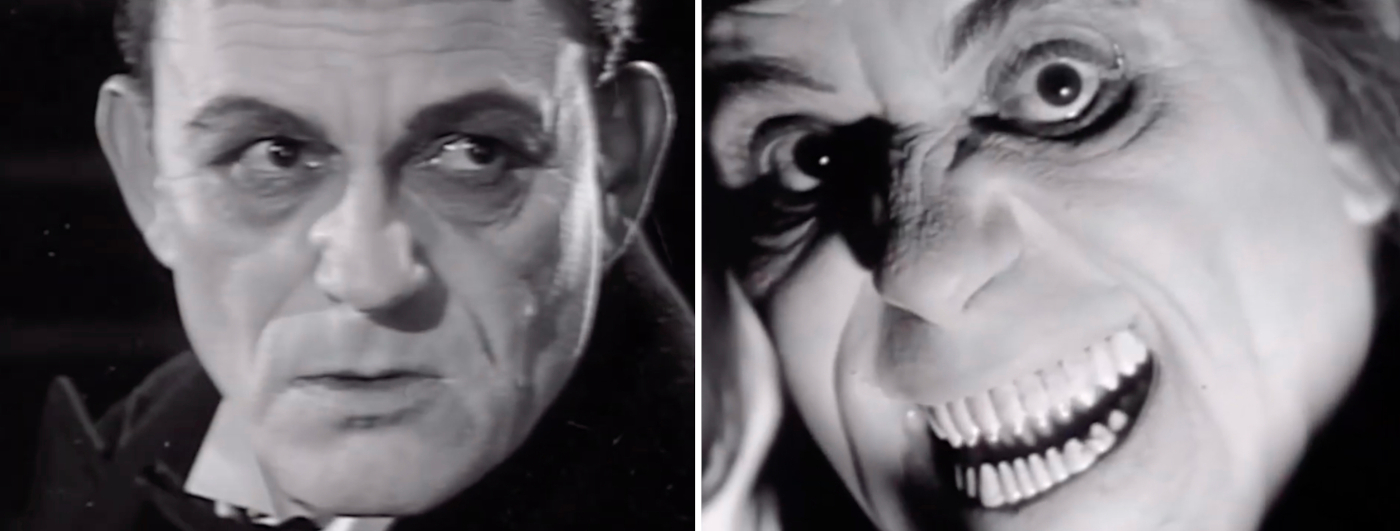
What’s with the images of Lon Chaney? The one on the left might be an AI generated ‘almost’ image of the great silent actor. We’re being flooded with interesting AI experiments; this week Gary Teetzel forwarded links to two parallel features touting ‘restorations’ of the lost horror thriller London After Midnight.
The first is from Sci-Fi N Horror A Go Go, with the title
It clocks in at 43 minutes. The second, from Bakémon: Japanese Monster Legends is called
and is 46 minutes in duration. They are curious exercises that grossly misuse the word restored. We immediately think of the disc companies that identify the cosmetic fixes they put on bad copies of movies, as ‘restorations.’ What the AI programs do is indeed impressive. Given a stack of high quality production stills plus the text of old intertitles, each AI experimenter has cobbled together what I would call a clever ‘enhanced photo novel’ narrative.
It’s truly amazing how dimensional motion is created from still images. We see attractive but mostly static images that rely far too much on inter-titles to tell a story. As the original production stills mostly pose characters in sets, standing next to each other, that’s mainly what the individual shots show.
Most of the action on view is conveyed via push-in and pull-out trucking motions, that have little connection with the way most silent films look. One of the AI presentations uses a few dissolves between shots, something even less associated with the silent era. Fake digital ‘film damage’ scratches and dirt here and there, a real ‘fan made’ giveaway.
The experiments are interesting to see, and too easy to criticize. Every so often we see something clever, but in most shots characters just ‘hover’ in motion. Sometimes they appear to move in reverse. It’s like a slightly vivified slide show.
Why are we not ecstatic about the possibilities of AI in visual media? The idea that a lost film could be recovered this way is simply dangerous to cultural history. With more clever ‘borrowing’ of from other movies, one could probably concoct a bogus London After Midnight that would fool many viewers. We are already seeing completely bogus videos that can fool experts. AI could be the end of movies, and the political possibilities are much worse.
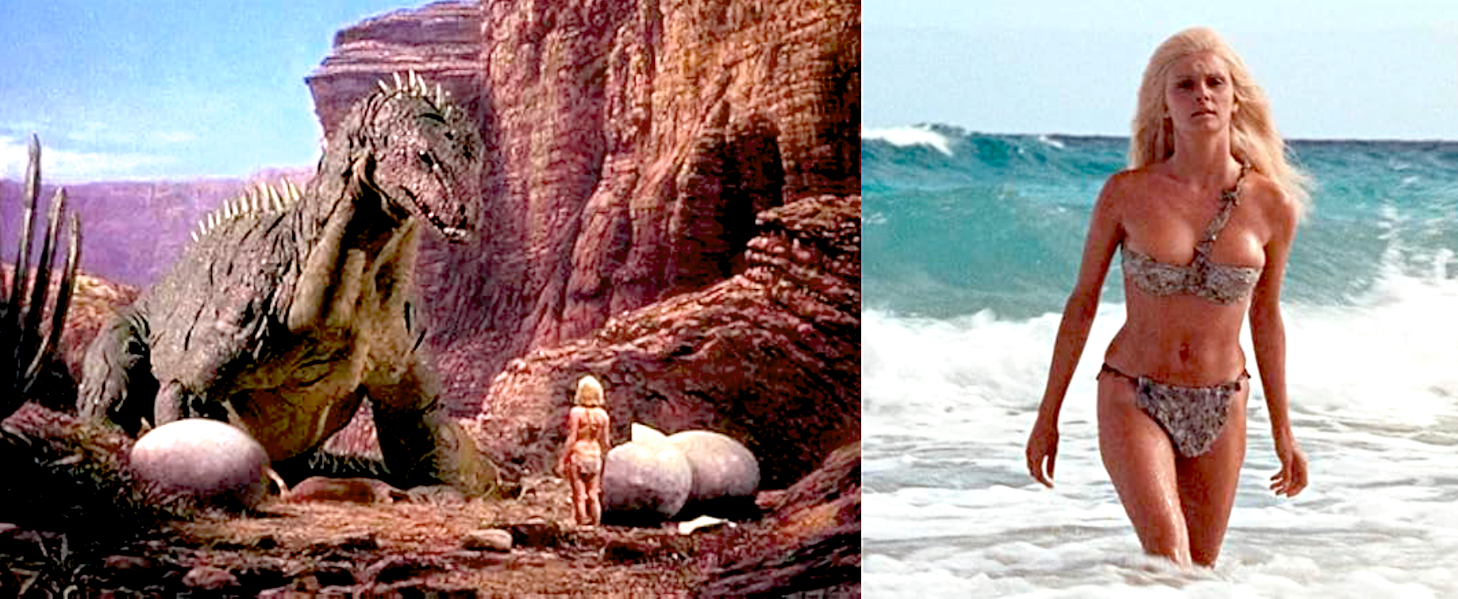
Michael McQuarrie found this 1970 publicity piece produced by Hammer Films, promoting actress Victoria Vetri and Val Guest’s When Dinosaurs Ruled the Earth. It begins with clips of Hammer’s offices just off Piccadilly Circus.
Sir James Carreras is fronted as the big name; the questionable voiceover identifies him as the ‘discoverer’ of Ursula Andress and Raquel Welch. We see a quick blip of (I think) Aida Young, the real producer of When Dinosaurs. We get a bit of behind the scenes footage, and some abbreviated shots of Jim Danforth dinosaurs that include a random shot from the 1960 The Lost World. Is the Ms. Vetri-versus-Snake scene in the completed film? I don’t remember. [Note, 12.28.25: Bill Shaffer remembers … and says that both the snake scene and the Lost World stock shot are in the finished film…]
Thanks for reading! — Glenn Erickson