
CineSavant Column

Hello!
Just one review today — last Friday we ran East ‘to the river’ on family business, and my one peek at the Colorado lasted just long enough to take this snapshot. (Hey, it’s not even level.) Then we returned just in time for a rough night in L.A.. I don’t know how it was reported elsewhere, but most of our local coverage was pretty sensible.
Thanks for the concerned notes. The city was not in danger of ‘being obliterated.’ We are not ‘a city of criminals.’ We’re fine, and thinking about everybody caught up in this. I felt proud of our L.A.P.D. for doing the best they could to keep a lid on this no-win situation. Talk about being caught in the middle.

— A Book Review —
First up today is a look at a new film-related book described by its publisher Summit Books as Historical Fiction. The Director illuminates the life and unique career predicament of the famed European film director G. W. Pabst. His name is now remembered to film aficionados as the genius director of the classic Pandora’s Box, The Threepenny Opera and Kameradschaft. Instead of an academic study, this fictionalization describes Pabst’s strange fortunes … that found him becoming a film director under the Third Reich.
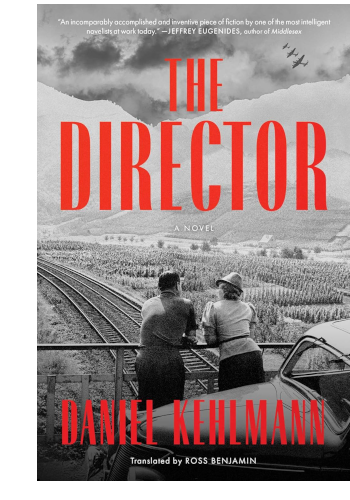
Daniel Kehlmann’s has been translated from German by Ross Benjamin. The novel is formatted not as a straight narrative with one viewpoint, but as several dozen ‘scenes’ from shifting perspectives. More than half are from the viewpoint of Georg Wilhelm Pabst himself, but they range across several associates and family members. Thus we skip the full filmography, the star name-dropping and the dry talk about being hired for this film and not for that one, etc.. For instance, the first chapter is with a former Pabst assistant, now approaching senility. Thrown onto a TV talk show, he is ignored when he tries to clear up some misinformation about the great director. Pabst’s reputation was sustained in postwar Germany for his discovery of Greta Garbo. His greatest films are from the silent and early sound era. His name is sometimes associated with controversy — he spent the war years in Germany, and worked on films for the Nazi establishment.
Kehlmann’s narrative tells a different tale. An Austrian national, Pabst is one of Germany’s biggest director-celebrities. His wife Trude, a former aspiring actress and writer, has sublimated her career to that of her husband. When the Nazis come Pabst decides that the new political climate is not for him, and quietly leaves for Hollywood. But his time at Warner Bros. yields only one film over which he has no control; unlike Fritz Lang or Ernst Lubitsch, he hasn’t the aggressive personality for the struggle of studio politics. He takes his wife and young son to France for several films, before making the defining mistake of his life. Visiting Austria to find a nursing home for his aged mother, the Pabst family is trapped when war is declared. It’s an acute case of bad timing. The borders are closed to everyone, and his papers and visas are meaningless.
The real subject of The Director goes beyond ‘The Movies,’ to the psychology of political oppression. Author Kehlmann has a lot to say about the consequences of ‘going along to get along.’ Depending on what one reads, Pabst was either a voluntary convert to the Nazi system, or he was forced to make movies for the Reich. It didn’t matter that his reputation was that of a ‘Red’ director, having filmed Kurt Weil’s musical play, as well as the sharply pacifist (and Reich-banned) Kameradschaft. Josef Goebbels very much wanted Pabst as a PR boost for his Nazi film industry.
At his home in Austria Pabst is intimidated by a peasant caretaker, a Nazi zealot who forces the Pabsts to live in their own servants’ quarters. A Nazi representative soon arrives to courts and cozen Pabst into taking a meeting with Goebbels, whose manner is terrifyingly faux-hospitable. Pabst doesn’t have to make political entertainment, but the subjects are bland. He’s asked to co-direct a ‘mountain’ film with Arnold Fanck, which gives us several episodes with actress / director Leni Riefenstahl. She is characterized as a manipulating egotist. These encounters are almost like play-scripts, with rich dialogues. G.W. and Trude cannot speak their mind in public for fear of being denounced and imprisoned; although Pabst is in his ‘fifties he could be also be conscripted and sent to the Russian front. In Berlin, poor Trude must attend tea parties with Nazi wives intent on enforcing the Party Line. Her fear and isolation worsens. We also are present for Pabst’s son’s experience in school, learning how to be a cruel Hitler youth, so as not to be victimized by other aggressive boys.
What we get is a convincing transformation of G.W. Pabst into a shell of his artistic self. He is still the smartest person in the room. He retains some authority yet knows he must bend to the will of his masters. At times the text expresses Pabst experiencing waking hallucinations, with action repeating itself, as if he is attempting to ‘direct’ a reality he cannot control. Kehlmann’s imaginings of Pabst’s encounters with a dozen vivid personalities. Back in his Hollywood exile, he visits with his former muses Louise Brooks and Greta Garbo. One is the secret love of his life, now unable to get work and practically a nobody. The other is such a big star that he is no longer qualified to direct her. The final debacle in wartime Czechoslovakia is Pabst’s fixation on a single film project. He obsesses over it as a way of blotting out the chaos and madness around him. Thus when Czech partisans break through, Pabst is caught with other fleeing Germans, trying to escape with his precious film cans in tow.
Kehlmann reserves several ironies for later chapters. He doesn’t touch on what most of us know as Pabst’s ‘twilight’ film Der lezte Akt, about Hitler in his bunker. We instead get a sad episode with G.W. producing and directing a film written by his wife Trude. Ironic postscripts show the lack of closure for Pabst, as his lost and uncompleted film haunts his later years. In her subsidized apartment in Rochester, Louise Brooks’ recounting of G.W. Pabst’s glories can only go so far — she appreciates art too, but what does it all really matter?
We found The Director to be an excellent read. Kehlmann’s publisher accurately defines the subject at hand as ‘art, morality and the human condition.’ Author Daniel Kehlmann plays his game honestly, reminding us in a postscript that The Director is indeed fiction — many story specifics and characters are invented, including one of the major players. But the story of an artistic life under a crushing political regime feels real. In a format of extended sketches, we’re given a fully rounded experience — an insightful one for troubling times.
The Director is published by Summit Books. We found it on Amazon here:

More Book Business.
This second column item is for a book I wanted to order for my daughter … but it’s not going to be available until next January. The University of Minnesota Press has an announcement up for The Luminous Fairies and Mothra. It’s actually a publisher’s announcement, apparently for academic appraisal. The book’s cover graphic is quite appealing.
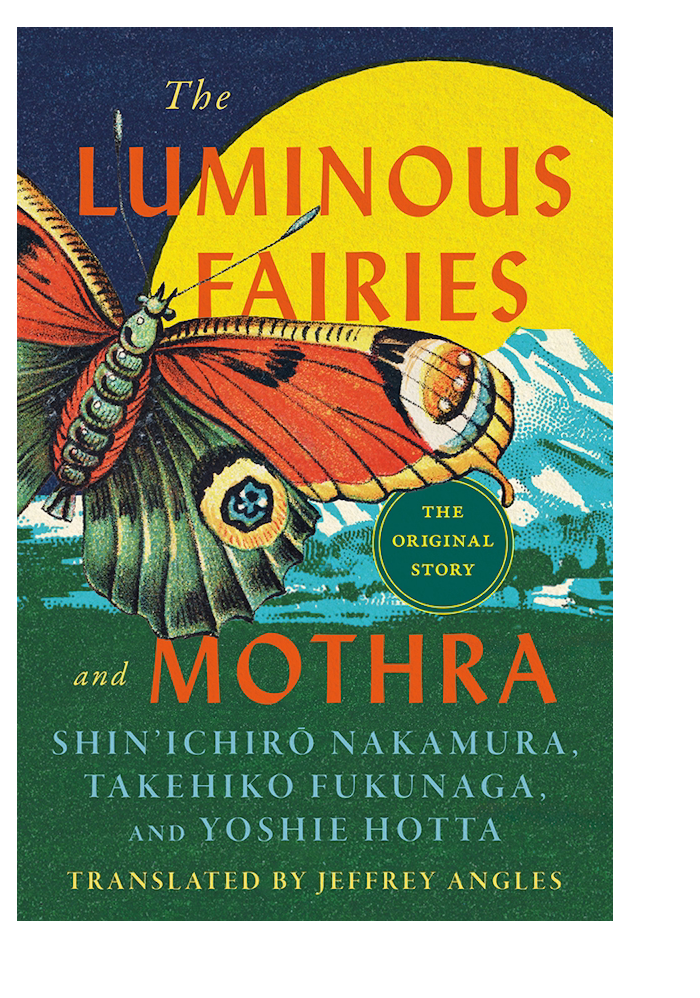
The movie Mosura, it seems, is not a screen original, but taken from a story by Takehiko Fukunaga, Yoshie Hotta and Shin’ichiro Nakamura. It’s fairly well-known in Japan, and has been described somewhat on audio commentaries for the movie. But this is the first time it will be available in an English-language translation, by Jeffrey Angles.
The basic story is similar, with fairy tale qualities imposed on a giant monster tale with political implications. The film’s storyline has a political message on its surface: a predatory capitalist-gangster from the powerful and exploitative country ‘Rolisica’ exploits a magic island, kidnapping a pair of tiny princesses to perform in a stage show in Tokyo. When the island’s gargantuan insect God Mosura swims to Japan to rescue them, Japan is the first nation to suffer. Without too much effort in decoding, ‘Rolisica’ would seem to be a conflation of Russia and America. Japan is an honest and innocent world citizen, caught in the crossfire.
For some tots it’s Winnie The Pooh, but there are other classics …
Years ago I wanted to take my then very young daughter to a revival screening of Mothra at the Alex Theater in Pasadena. To help her get the basic story down, I drew a little comic book she could read. Afterwards, I made a video of her narrating the story. It was a big hit. The video survived, and then we even located the original comic a few years back …
Coming in January — ? —
Thanks for reading! — Glenn Erickson