

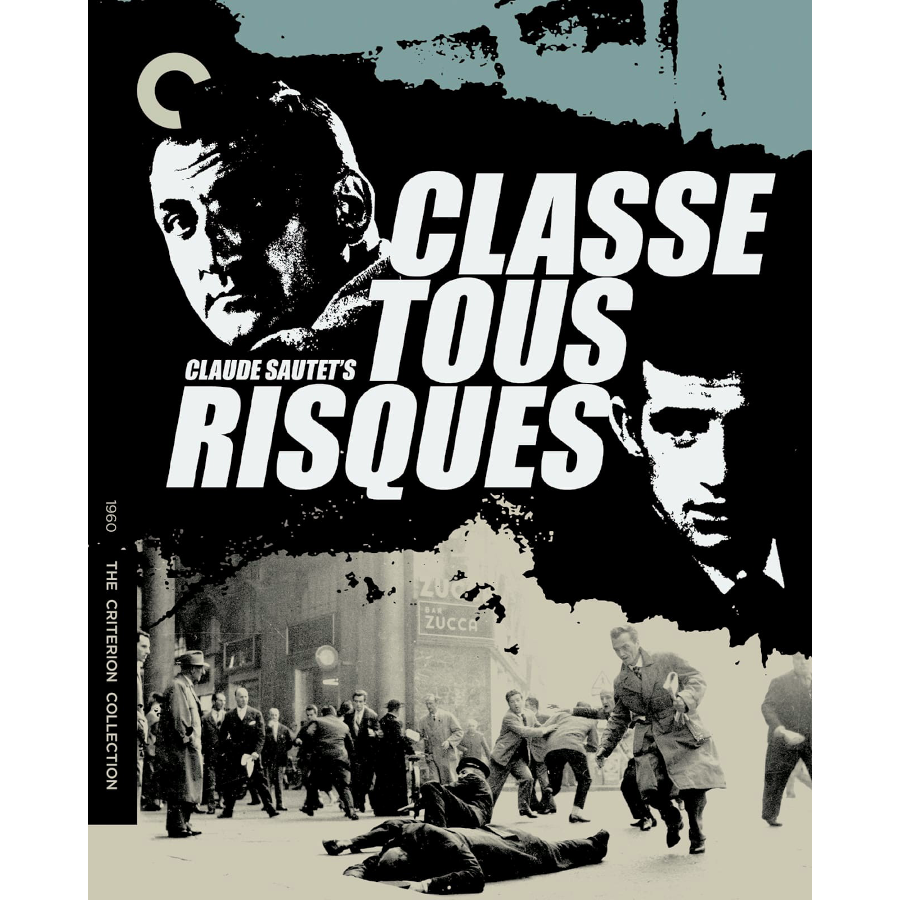
Classe tous risques — 4K 03/14/26
The Criterion Collection
4K Ultra HD + Blu-ray
In what some consider the best classic crime film to come from France, writer-director Claude Sautet and writer José Giovanni give star Lino Ventura the role of Abel Davos, a convicted crook in a squeeze play. When he tries to return to Paris he’s forced to abandon his wife and boys as both the law and his faithless cronies close in for the kill; he gets help from gunman Jean-Paul Belmondo and a girl they meet on the road, Sandra Milo. It’s a tense situation at all times — Davos’s consistently outwits his foes, but his good luck can’t last forever. Remastered in 4K Ultra HD, it looks like a new picture. On 4K Ultra HD + Blu-ray from The Criterion Collection.
03/14/26
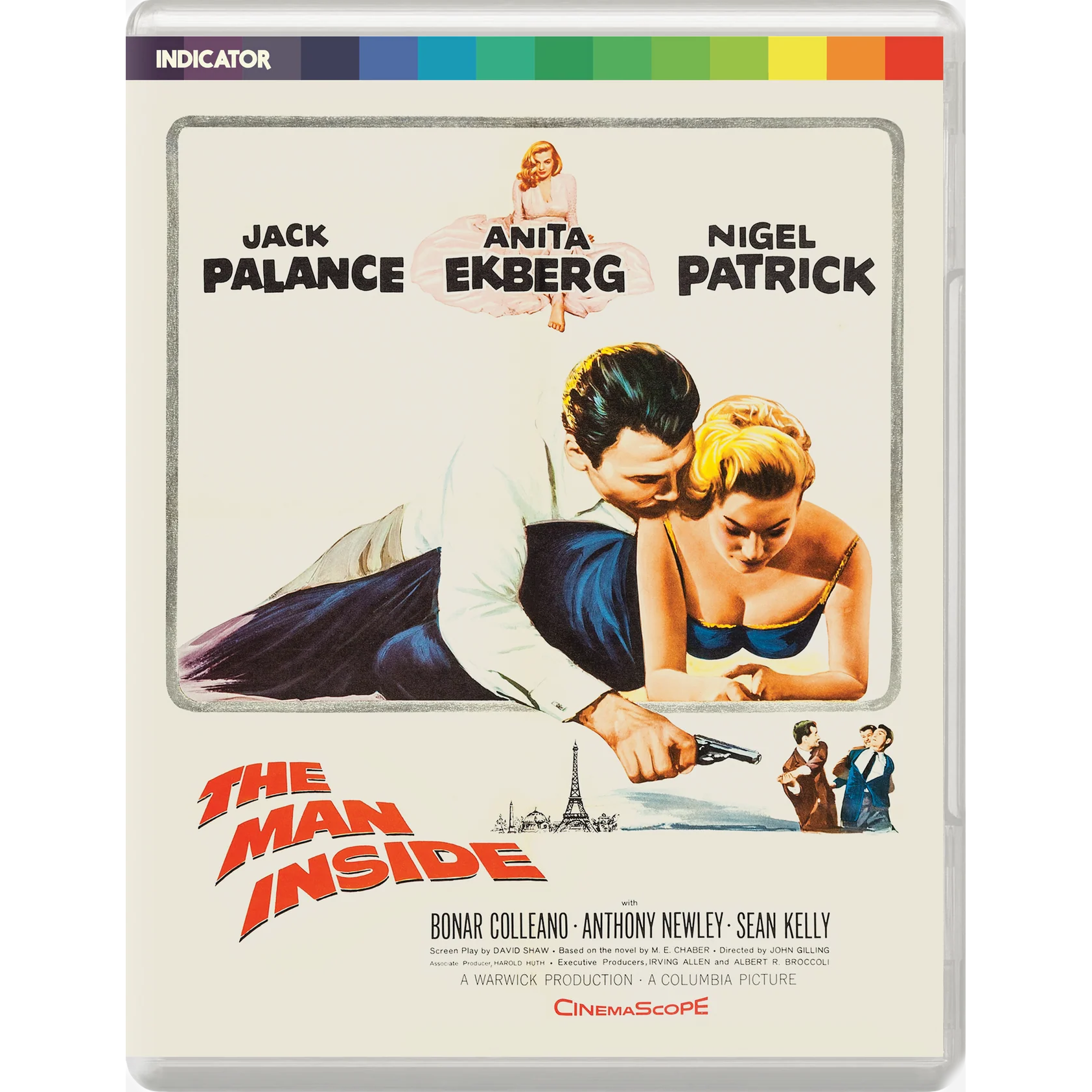
The Man Inside 03/14/26
Powerhouse Indicator
Region B Blu-ray
Powerhouse Indicator dips into the Columbia library for a Warwick Films production from Albert R. Broccoli and Irving Allen. It’s an international genre blend that would seem a stab at the perfect mainstream box office formula — crime violence, a tough American star, a sexy European star, upbeat music and comic relief around the fringes. Bruiser Jack Palance plays it non-brutal, Anita Ekberg is a cool femme fatale and Nigel Patrick is an eccentric jewel thief. It’s a definite pecursor to Broccoli’s future James Bond franchise. On Region B Blu-ray from Powerhouse Indicator.
03/14/26
CineSavant Column
Hello!
It’s a Book Review Day.
A fistful of years ago, we first encountered Chris D.’s movie writing in his encyclopedic look at Japanese crime and Yakuza films, Gun and Sword (scroll down to May 25). Those 900+ pages are still a key item on my reference shelf. It is one of those books that makes one realize that the worldwide volume of film and film art is much bigger than we thought.

At first glance, the title of Chris D.’s new book makes us think he’s taken a dive into film noir commentary. The launch point is a section on the great femme stars of film noir, a series of essays on ‘The Humanity of Femmes Fatales’ through a group of individual noir actresses. That core theme is just the springboard for an expanded body of writing that ranges far and wide. The list of chapter headings promises interesting reading on a wide range of film trends, with a focus on genre studies, taking on directors and individual films from around the world. It’s the kind of book in which one scans the 5-page index and finds a half-dozen items one wants to read.
There is an overarching organization, but our first attention went to individual films Chris chooses to closely profile. Just a quick sampling: Johnny Guitar, Baby Face, End of the Affair, The Camp Followers, The Night Porter, Machine Gun McCain, Adua and her Friends, A History of Violence, The Devils, Deep End, Bi Gan’s 2018 Long Day’s Journey into Night. It’s a fairly eclectic selection,

Chris served for years as a programmer at The American Cinematheque on Hollywood Blvd.. One might think that all that time organizing screenings would have turned him into a movie house zombie. No, he apparently continued to engage with the films themselves, compiling a mental diary of his reactions.
Chris D.’s writing style pulls one in — his concentrated thought process expresses aspects of the film experience not covered by an academic approach. We like scholarly essays, and the book does carry a sub-title worthy of a thesis paper: International Noir/Neo-Noir: Signifiers, Gender & Beyond Genre. But we found it easy to get into Chris’s flow of words and ideas. It’s a very personal account. Chris’s occasional asides are a reminder that our personal histories with films includes the particulars of how we saw them. I identify with that approach. Specific movie experiences are etched in my memory timeline, too … remembering the where, the when and the with whom.
Chris has interesting opinions to impart, and he communicates them well, in short bursts of honesty. A random example is his assessment of John Sturges’ Bad Day at Black Rock. We had internalized the critical praise given the film’s use of CinemaScope. Chris instead sees Sturges’ blocking of a large cast on the wide ‘scope screen as stilted, and relates it to his view of the characterizations as also schematic, superficial. There’s no snark factor to Chris’s observations, none of the attitude of a reviewer trying to be clever. We instead think, ‘oh, maybe Black Rock could use some reassessment.’

The book is not just for readers already familiar with the films he covers. It has potential appeal for film school / film culture newbies searching for new corners of cinematic interest. Some of his categorized overviews are accompanied by lists of films, some annotated and some not. These also carry his personal ratings, that are not a generalized good/bad barometer. He often makes use of detailed movie synopses, which I find helpful in that they emphasize the elements he feels are relevant.

The film writing from across the years includes Chris’s unfiltered interviews with Samuel Fuller and Mary Woronov published long ago when Chris was connected with the L.A. punk scene tabloid Slash. The tome is 826 pages long, and mostly dense text. There is a large section that’s again devoted to Japanese crime pictures, that for a few pages made me think I was back in Gun and Sword again.
That first set of Noir essays collects a group of core noir masterpieces, but the focus is on the femme fatales — each features a key actress illuminating, in Chris’s view, another aspect of gender dynamics. Not political gender dynamics, but perhaps the pondering of ‘how do the sexes get along, in the first place.’ Chris’s occasional asides tend to be choice — we wonder how someone’s love life would fare, if they tried to organize their personal relationships through what most films noir teach us about women.

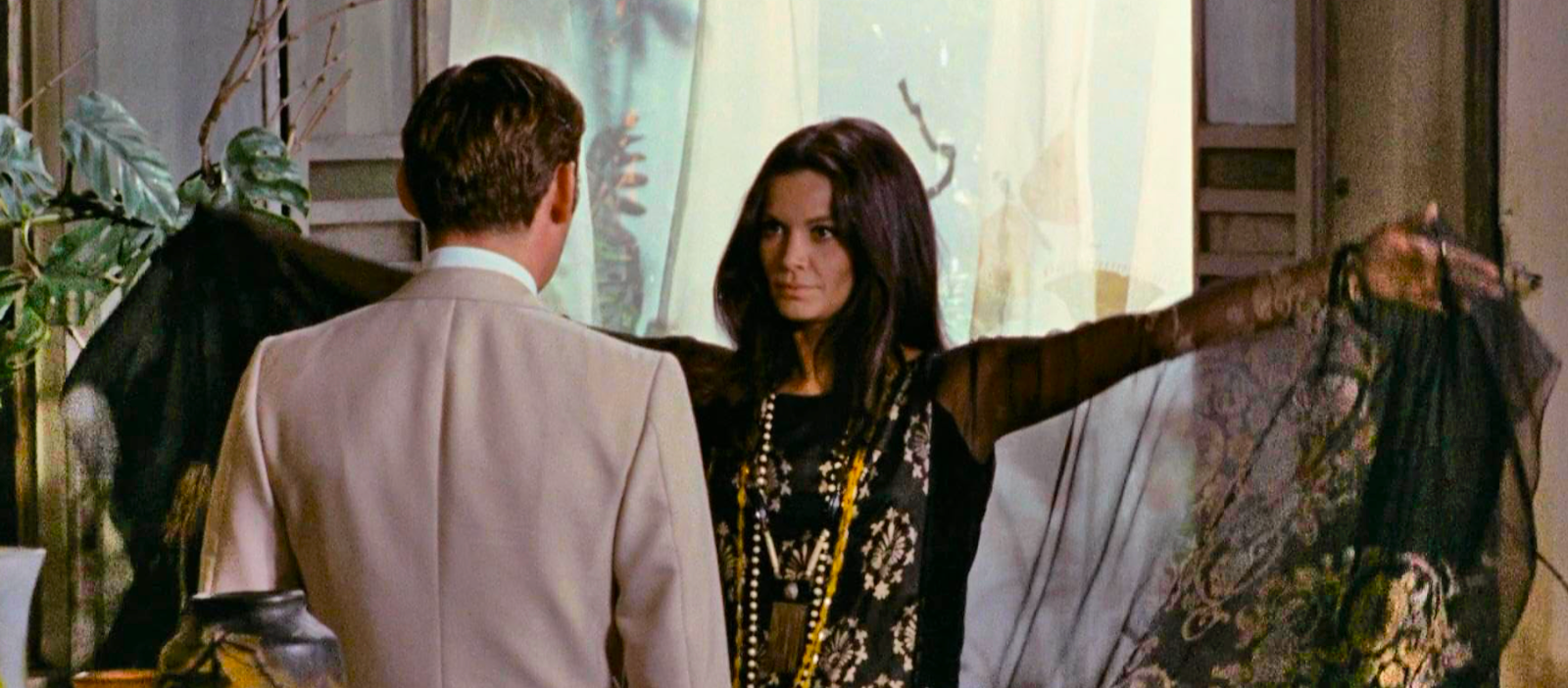
Again the scope of interest is broad for this compendium of film writing from a special point of view. Chris D. devotes entire sections to non-pantheon Italian and Japanese masters. The choice of screen artists grabbed us right away: Florinda Bolkan, Francesco Rossi, Hideo Gosha, David Cronenberg, Leonard Schrader, Claude Chabrol, Robert Hossein. He looks into the Alain Delon & Romy Schneider affair, the evolution of Twin Peaks and the films of Nicolas Winding Refn.
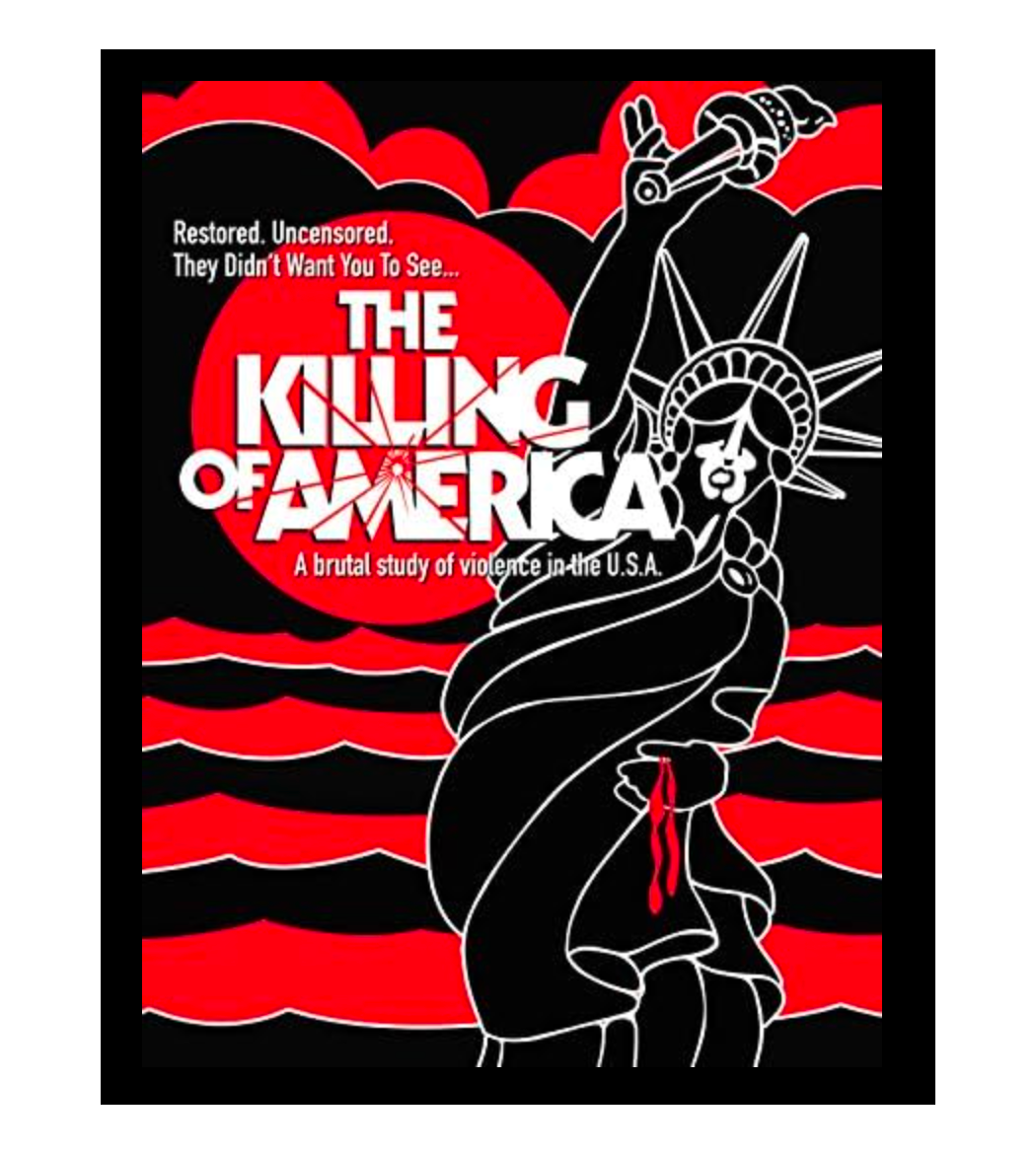
The book has plenty of B&W photos and other illustrations. The table of contents is inviting but no index is in the back. My copy already has several post-its to mark things to re-read, that I didn’t want to lose track of. (My bookshelves aren’t pretty, but they are practical…) I have not yet read the essays on Alfred Hitchcock, John Cassavetes and Yasuzo Masumura, knowing they’ll be there when I’m ready.
Chris doesn’t hold back — he’s there with an opinion for everything and more than a few value judgments. Reactions to The World According to Chris will of course vary, but I found him level-headed and open minded. I was attracted to his choice of topics, and never disappointed by what he had to say.
We frequently come across $60 film books that can be read in an afternoon, yet still feel insubstantial, padded. Chris D.’s killer softcover is just the opposite. It’s a recommended deep-dive read.
International Noir and Beyond Genre
Thanks for reading! — Glenn Erickson

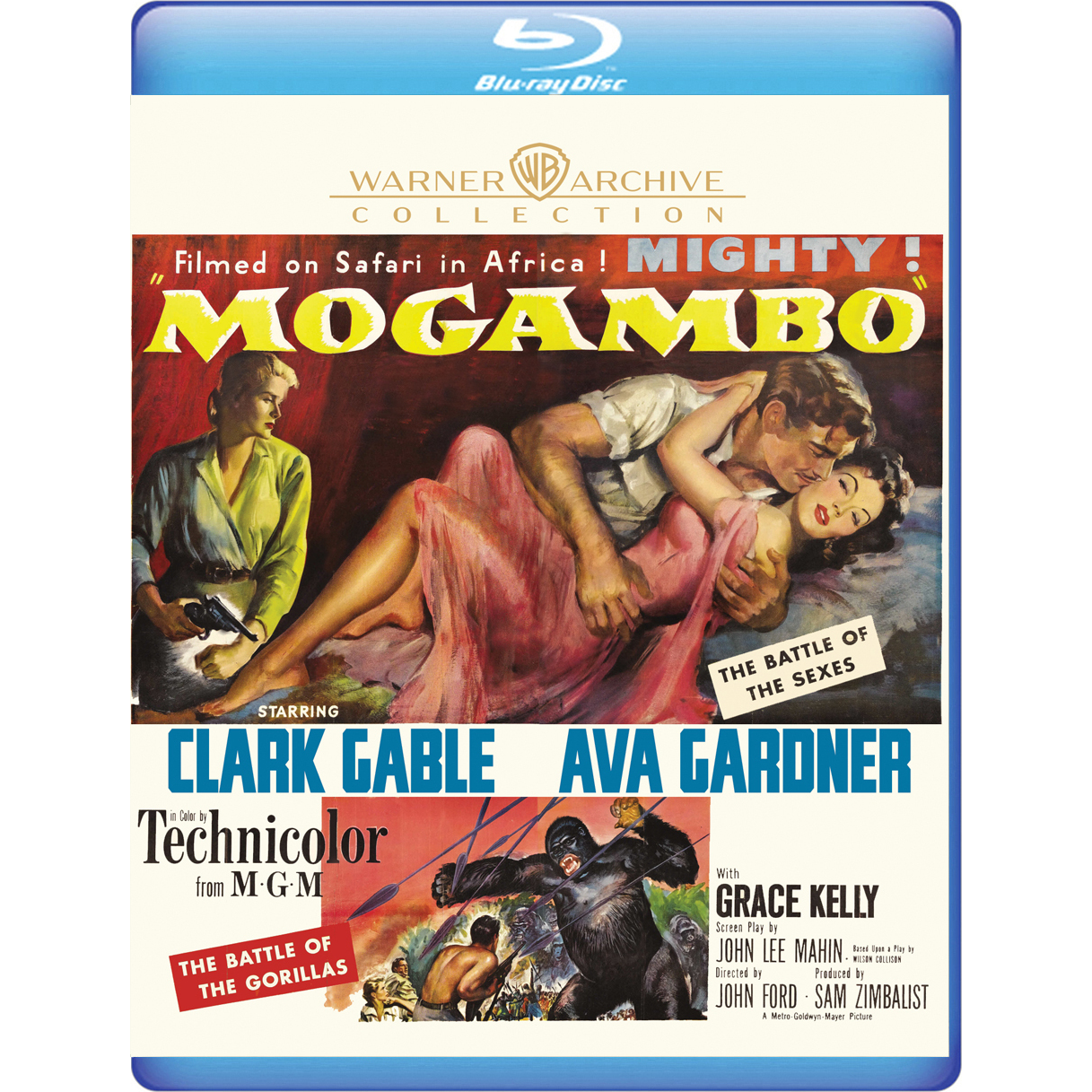
Mogambo 03/10/26
The Warner Archive Collection
Blu-ray
John Ford went to Africa and brought home a fine remake of a 1930s pre-Code hit, with its original star Clark Gable. Clark has his hands full juggling leading ladies of the next generation, Ava Gardner and Grace Kelly. Gable is still the he-man center of attention; his advancing age is not a restrictive factor, not quite yet. The adaptation takes advantage of the African locale with the added oomph of Technicolor. It was box office gold for MGM, even with a much more chaste ‘bath in the tropics’ scene. On Blu-ray from The Warner Archive Collection.
03/10/26

The Day and the Hour 03/10/26
KL Studio Classics
Blu-ray
René Clément all but invented the resistance movie in France and returned to the topic several times. This story of an American flier and a Frenchwoman avoids political sentiment and escapist excesses, concentrating on Simone Signoret’s luminous performance as a woman facing the worst that Occupied France could dish out. It’s a multi-language production, filmed from Paris to the Pyrenees. Stuart Whitman is the American pilot, and the French cast is choice: Geneviève Page, Michel Piccoli, and Reggie Nalder. On Blu-ray from KL Studio Classics.
03/10/26
CineSavant Column

Hello!
Advisor Gary Teetzel reminded me of this attractive disc, said to be coming down the pike from the company ClassicFlix. I remember Olive Films releasing several volumes of Betty Boop cartoons on Blu about a decade ago. This compendium of Max Fleischer hits throws a wider net — looking at the titles, even I recognize some great, one-of-a-kind animation masterpieces.
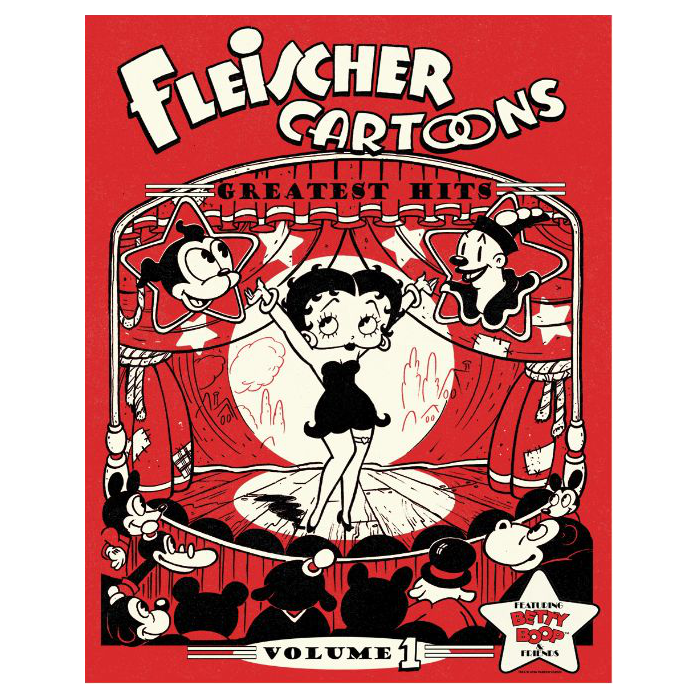
It all depends on the quality, but ClassicFlix is promising that the disc will measure up.
One of the better experiences in Film School was Bob Epstein’s animation class, which showed original prints of everything from Lotte Reiniger to Ladislas Starevich to Tex Avery to Ray Harryhausen. Bob demonstrated that the art was a lot more than Cartoonarooney Fun. He had a particular yen for early Max Fleischer, especially some of the silent Koko the Clown classics. They showed us 1970s faux-hipster know-it-alls that our generation invented very little — everything surreal, subversive or sexually provocative had arrived way before. Before a big screen presentation of some classics in Royce Hall, he screened Koko’s Earth Control, an apocalyptic preview of Crack in the World, only completely insane.
The link below takes one to ClassicFlix’s sales page, for the curious — this first Greatest Hits volume combines remastered Fleischer marvels of Koko the Clown, Bimbo, Popeye the Sailor Man, Superman, and of course, Miss Betty Boop. The expected arrival date is May 26.

And correspondent Scott Stirneman surprised me today, with something I’d forgotten about entirely.

Back in the days of DVD Talk I spent a lot of time organizing and trying to keep current a ‘DVD Savant Wish List’, to which readers could contribute desired titles. It was plenty popular, as it reflected the frustration in the first years of DVD that ALL of our FAVORITE discs weren’t coming out fast enough. I knew the pain of various disc boutiques. After making an all-out effort to release some highly-desired feature, when it arrived the fan base only demanded more discs, the ones that those stingy studios and disc companies were hoarding. That of course wasn’t the case (most of the time), but I remember the attitude very clearly.
What I forgot was where these Wish Lists were — they weren’t linked like the thousands of other DVD Talk / DVD Savant reviews. It’s rather nice that that old content hasn’t been taken down from the web, 25 years later. Someday it will surely disappear, which is why we’ve retained backups here. When that happens, Assuming I’m not six feet under (I’m not holding my breath) I should be able to recover any review, complete with misspellings, mixed metaphors, head-scratchingly odd syntax and pathetic attempts to be clever. It’s what the world needed in the Clinton and Bush years, that’s fer shure.
I think this Wish List is the last one from 2012, after which I begged off — it required an extra hour a week in text management. Long-time Savant readers may find their own names listed. It starts off with that of Brad Arrington, a steady correspondent who suggested many titles, who is now gone. I told the kindly Mr. Stirneman that I was grateful for his help locating the lists. My plan is to print this last one out — the ‘collectors’ game’ could be to cross off all the AWOL titles that have since appeared — and in Blu-ray or 4K, to boot.
And hey, it’s good nostalgia for my websites, reminding me how well I’ve succeeded in keeping them stupendously unprofitable!
For fun, this extra link may be my first stab at a wish list … from (cough) 2002. The text will show me where my greedy disc-collecting brain was at back then, you know, when we were so, so, young.
Practically everything on this 2002 list is now on the shelf here at CineSavant Central, in one format or another:
Thanks for reading! — Glenn Erickson


Playtime — 4K 03/07/26
The Criterion Collection
4K Ultra HD + Blu-ray
Reviewer Charlie Largent plumbs the comedic mystery of Jacques Tati’s eccentric conceptual masterpiece, originally filmed in 65mm. Tati’s iconic character is adrift in a modern Paris of glass buildings and confusing habits, observing ‘civilization in action’ in one fascinating set-piece after another: an Airport passenger space, a cubicle-forested office, a trade show, the debut of a chi-chi nitery. It’s like a giant game of Where’s Waldo Tati … and mysteriously, charmingly positive-minded. On 4K Ultra HD + Blu-ray from The Criterion Collection.
03/07/26

The Second Woman 03/07/26
Film Masters
Blu-ray
Upscale country-club noir: James V. Kern’s well-directed psychological drama has become semi-obscure for a number of reasons but has been resurrected in decent shape, yielding a handsome show with some unusual casting. Trying once again to play against type, Robert Young is a troubled architect who may have a murderous skeleton in his closet; cheerful light comedienne Betsy Drake is terrific as an assertive woman who won’t let go of his problem. Independent producer Harry Popkin gives the show an air of glamour — the setting is the beautiful shoreline between Carmel-by-the-Sea and Monterey. On Blu-ray from Film Masters.
03/07/26
CineSavant Column

Hello!
Lets proceed with optimism, even if the global forecast is — well, it changes every 45 minutes.
We found some cute stuff for this weekend’s Column. Michael McQuarrie directed me to the Film Board of Canada’s latest website, to see a movie about Buster Keaton. Unfortunately, the Canadians were blocking it, along with other content, with placards reading ‘Not available to view in your current location.’
In truth, I am grateful that Canadians are still having anything to do with us. That goes for pretty much the world right now.
But there are so many super, hilarious Canadian animated films. I looked up an old favorite short animated film, which thankfully was viewable. We caught up with this particular mini-masterpiece on early DVDs, 25 years ago. It is To Be by John Weldon, and features the great voices of Kim Handysides and Howard Ryshpan. It’s a science fiction fable, and as such was written up with great enthusiasm for my old DVD Savant Sci Fi Reader (gee, anybody interested in a follow-up book?).
It’s hilarious, insightful and genuinely profound … and has a cute song, too. If you haven’t seen it, do — it’s not long and the online copy is flawless.
To Be
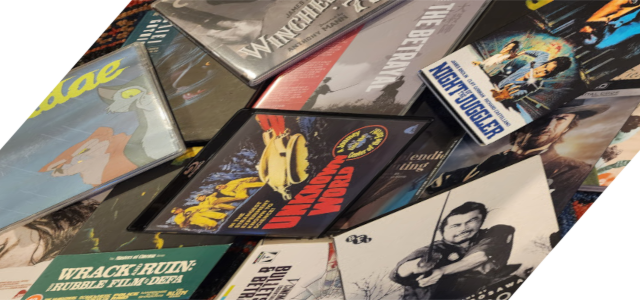
And once again we’ve been graced with a fave disc list from Kyu Hyun Kim, whose opinions have always impressed me, along with his knack for communicating the special appeal of a picture in fewer words than I thought was possible.
We reviewed several of these titles — Unknown World, Winchester ’73, Yojimbo / Sanjuro, World Noir No. 3 — and note that Kyu draws from a couple of UK & European companies that stay mostly inaccessible to CineSavant.
He once again he comes up with releases that never crossed my radar and as such now draw my interest. Interesting that his ‘top fave’ is a Kino Lorber Jean Belmondo costume picture!
Kyu’s comments go the extra step — he names the companies that he think are overtaking Criterion in the effort to bring forth more treasures from the hidden corners of cinematic history.
Thanks for reading! — Glenn Erickson

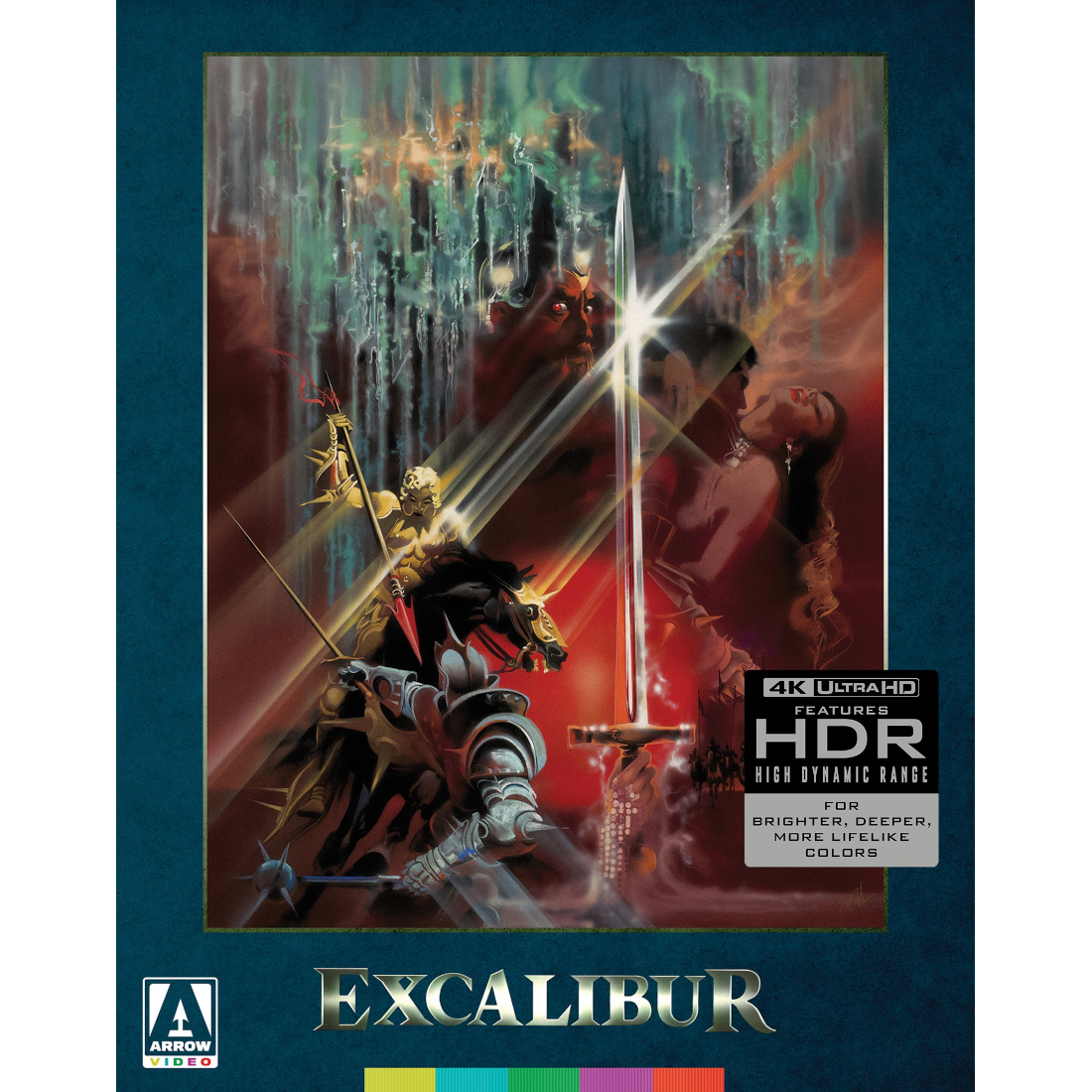
Excalibur — 4K 03/03/26
Arrow Films
4K Ultra HD
Not every John Boorman film landed on target, but this fantastic take on the Arthur legend is a big winner. Beginning the story a generation back with Uther Pendragon deepens our understanding of Arthur, Guenevere and Lancelot. Excess romantic bathos is dropped in favor of a return to the mystical roots that would underpin epics to come, including Tolkien. Merlin and Morgana (Nicol Williamson & Helen Mirren) are the really crucial characters, and the ensemble of knights and knaves is chosen for acting ability: Nigel Terry, Nicholas Clay, Cherie Lunghi, Gabriel Byrne, Katrine Boorman, Liam Neeson, Corin Redgrave, Patrick Stewart, Ciarán Hinds. It’s a beautiful remaster, for the first time at its original 1:66 aspect ratio. On 4K Ultra HD from Arrow Video.
03/03/26
Stranger on the Third Floor 03/03/26
The Warner Archive Collection
Blu-ray
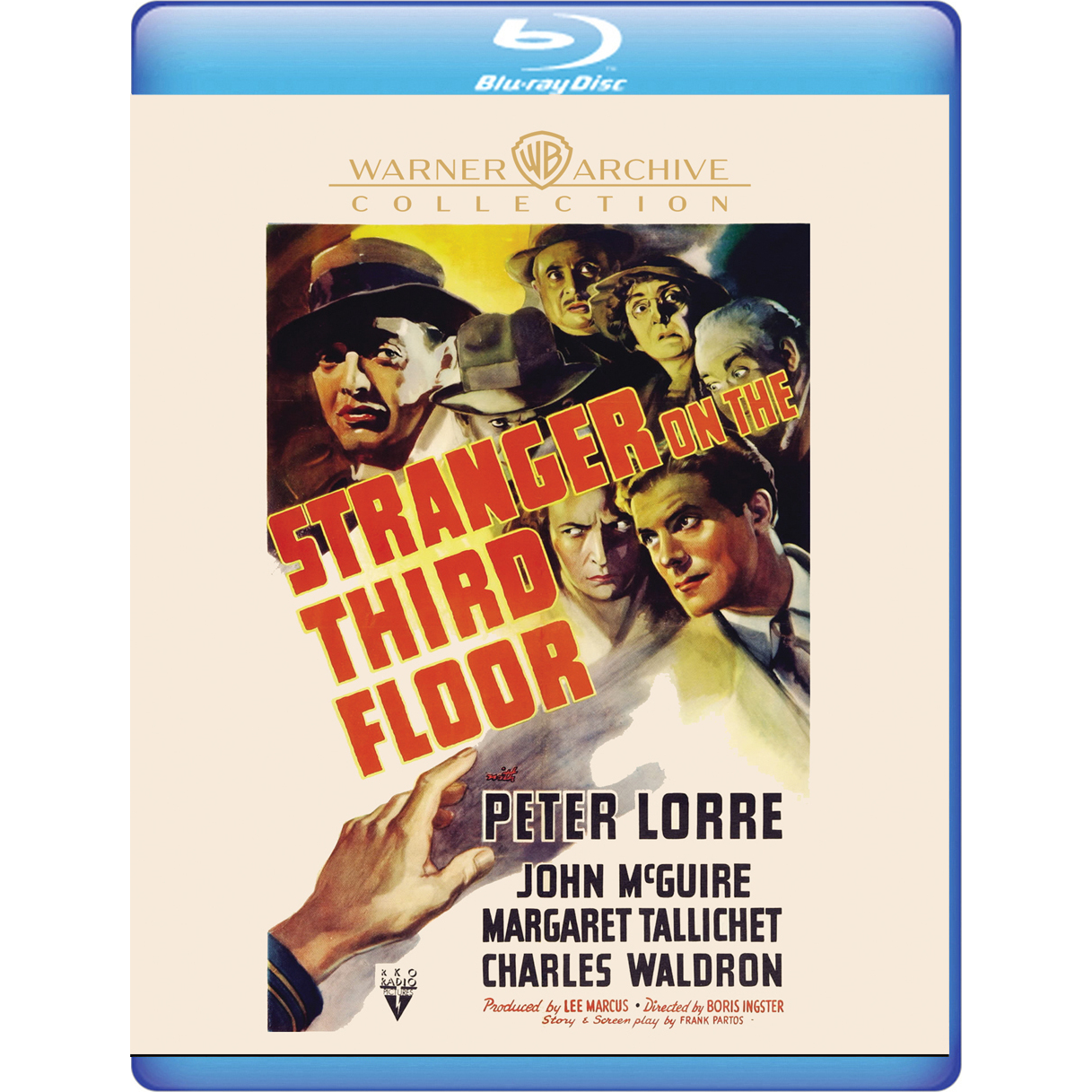
The stylized visuals in this RKO mini-masterpiece are more extreme than any of the German expressionist classics said to have influenced it. A cub reporter experiences a nightmare of crazy injustice, a psychological payback for his own testimony that convicted a killer on circumstantial evidence. The pale and forlorn face of Peter Lorre haunts this very strange melodrama, pitched somewhere between horror and a new style yet to be identified: film noir. Lorre is great, but so are the leading players Margaret Tallichet, John McGuire and especially Elisha Cook Jr.. On Blu-ray from The Warner Archive Collection.
03/03/26
CineSavant Column
Hello!
Here’s a sidebar subject that I know will interest more than a few CineSavant readers.
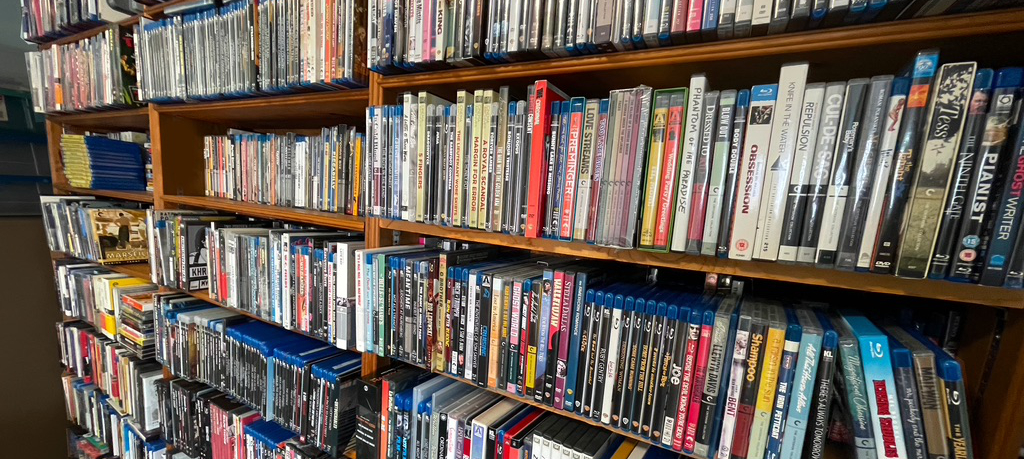
Many of us have more than one uncompleted ‘project’ going at home. I won’t list mine, but I’m well into a new project that’s pretty important — resolving the glut of discs that threaten to take over the house. As kids moved out, mountains of discs moved in, and I’ve got parts of two rooms tied up with the blessing / curse of video discs. It’s a helluva collection. I give a few away but I don’t toss many: no hoarders here, but we don’t casually throw things away.
Off and on I’ve posed the question, what do other collectors do with their collections? How many are just in a big mess, like me? I have imagined driving to Cincinnatti, ringing the doorbell at the house of Timmy Lucas, and saying, ‘Gee Tim, sorry to interrupt your recording session. Show me how you organize things, okay?’ Something tells me that Mr. Lucas has a system nobody but he could decipher.
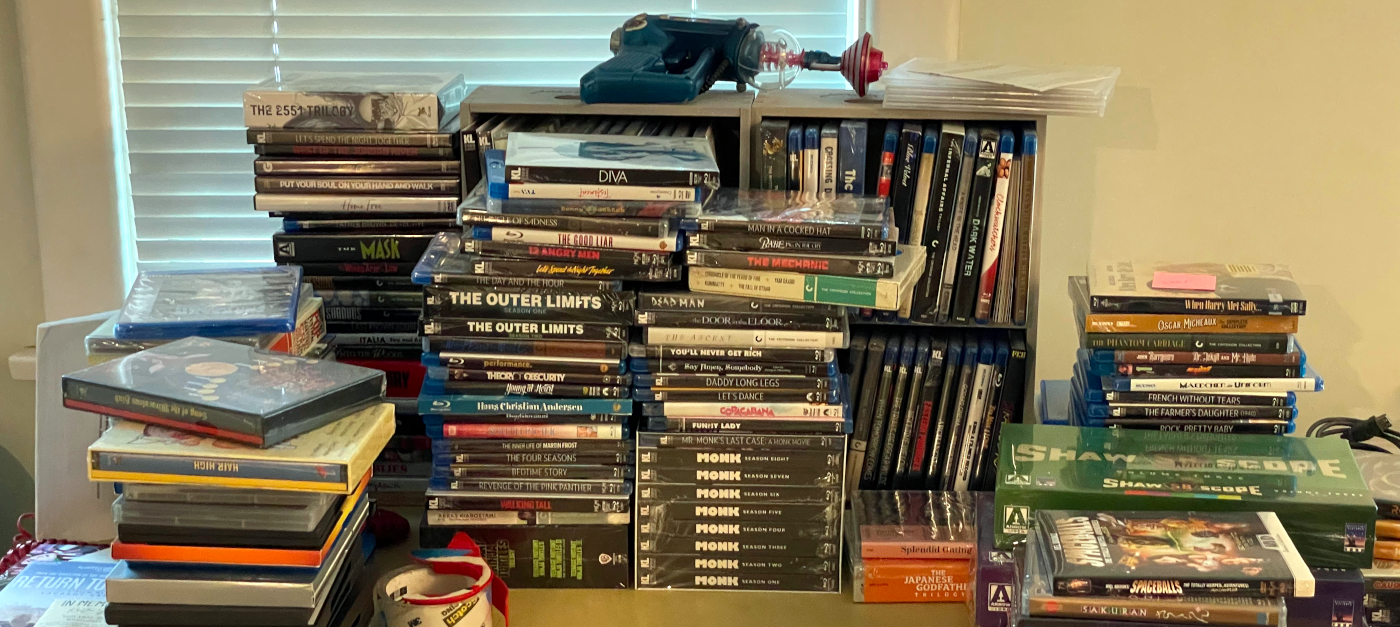
The top picture of long shelves, 2 discs deep, is what I sometimes put up at CineSavant. Well, only now am I showing the pictures of random discs stacked on any available surface, and boxes of discs stashed in every available space. It wouldn’t stress a fire marshall, but it ain’t pretty. Some of these boxes are indexed but most not. When Gary Teetzel or Allan Peach asks to see something, I either (a) know exactly where it is, (b) get lucky because it’s where my failing memory says it will be, or (c) a search must commence to track it down. Sometimes I have to give up. Sometimes I’ll come across the desired disc a year later, happy that I didn’t accidentally throw it away.

I’m impressed by collectors’ endless custom shelving, but know that’s not the solution for me. The house isn’t that big. The idea is to make the discs accessible, find-able. And not let them inundate the place, like videodisc Kudzu.

Just the same, I can no longer pretend that I’m amassing a fabulous cinema resource for the ages. Who knows what happened to the fabled contents of The Ackermansion, or to the vast holdings of film collector David Bradley? And who says that hard media will survive as a movie viewing format? The corporations seem to want hard media video to become extinct. I’ve chosen to make collecting these movies a big part of my life, but I don’t want to stick my grown children with a disorganized mess … my influence in their informative years was enough.
Meanwhile, a lot of space here is decorated with lovely stacks of boxes.
I’ve finally decided how to make ‘a project’ out of resolving this mess. The strategy comes from friend Craig Reardon. He collects discs, but doesn’t retain their packaging. He has a system in which he places each disc in a paper envelope. His couple-of-thousand discs are filed alphabetically in a handsome heavy-duty cabinet. They take up one-twentieth the space of keep cases.

Craig’s system ought to work for me … my problem is that I didn’t choose all of the discs I have here. I have no idea how many there are, really — I’ve reviewed 7,500 but have received many, many more. I am presently archiving discs in envelopes, like Craig, but giving them random numbers and keeping a digital index for them (on more than one computer). But unlike Craig I’m keeping the cover sleeves and the insert pamphlets, all numbered as well. You can see them bundled in the close-up photo of the drawer. I’m saving some keep cases, but tossing the rest. At the moment I’m preserving special packaging.
The idea is that my disc shelves will hold fewer, but more cherished discs. The visible collection might better reflect my personality.
Right now, with about 900 discs ‘enveloped,’ the big surprise is how much they weigh. I’m putting them in an ordinary chest of drawers, but they’re so heavy that no drawer is more than a third full — it feels like more strain would break something. So what’s the solution to that? Do I invest in archival cabinets? Do I put the discs in expensive, sealable plastic bins? Is there a cardboard solution? We’ll see what happens.
So far I’ve not been discouraged by spending hours numbering and stuffing envelopes, because I like seeing the boxes start to disappear. I should eventually free up this place for something great, like receiving family vistors!

This has been yet another personal CineSavant sidebar, but it’s at least related to disc collecting. My impractical advice to film fans is: (a) move down the block from me here in L.A. (b) Show up a my door with cookies or brownies. (c) Borrow whatever you want to see.
Thanks for reading! — Glenn Erickson


Ben-Hur — 4K 02/28/26
Warner Bros. Entertainment
4K Ultra-HD + Digital Code
Warners’ new 4K remaster of William Wyler’s towering Road Show blockbuster is a feast for the eyes and ears; the rich encoding will put the word ‘epic’ back into the home theater experience. Wyler’s tasteful direction of that costume-actor-for-all-eras Charlton Heston makes most Biblical epics look tawdry. The chariot race is an action set-piece that will likely never be topped. It was all performed for real, with stuntmen and real horses, and several thousand extras on a set as big as a collosseum. Plus Miklós Rózsa’s powerful film score. On 4K Ultra-HD + Digital Code from Warner Bros. Entertainment.
02/28/26
Dillinger 02/28/26
MGM
Blu-ray
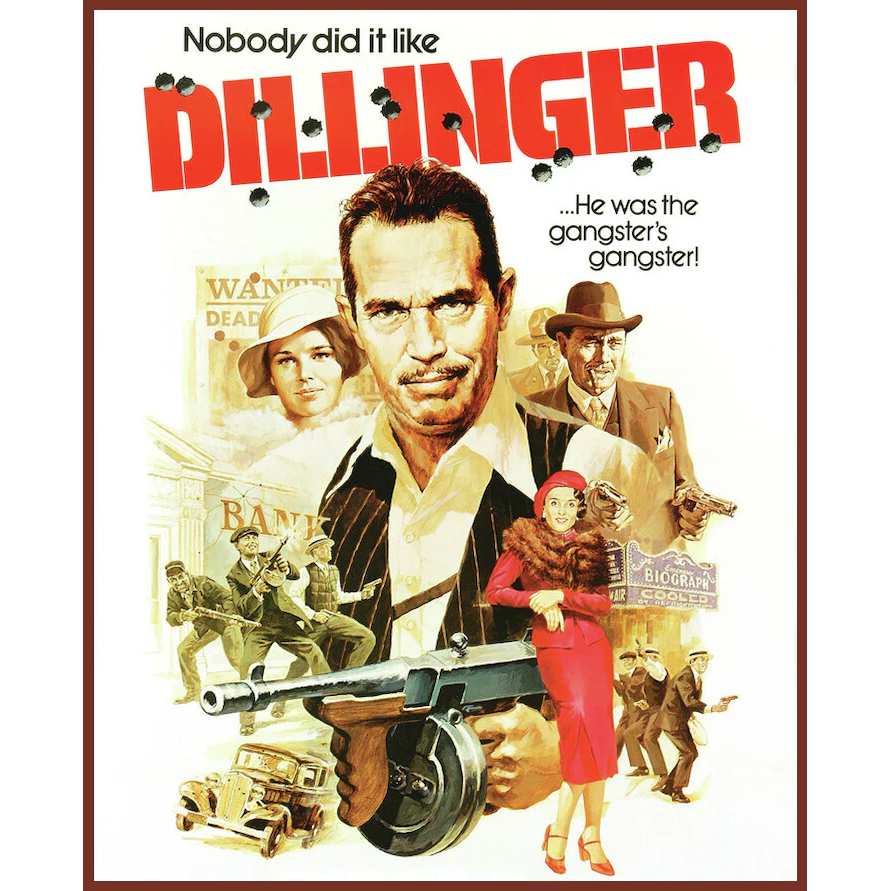
John Milius’s all-star gangland gundown is great fun for fans of gun action and America’s number one Public Enemy. Stars Warren Oates and Ben Johnson hail from Sam Peckinpah’s stock company, but the roll call of supporting gun thieves is just as stellar: Harry Dean Stanton, Geoffrey Lewis, John Ryan, Richard Dreyfuss, Steve Kanaly, Roy Jenson and Frank McRae. Michelle Phillips is a kidnapped gun moll, while Cloris Leachman has a memorable cameo as The Lady in Red. Bang Bang! — most of these rural bandits get themselves shot to pieces. On Blu-ray from MGM.
02/28/26
CineSavant Column
Thanks for dropping by. It seemed wrong to post normally today. Thanks for reading, kind thoughts to all.